

Issued by the United States Post Office Department between January and October 1940, the Famous Americans Series stands as one of the most ambitious and culturally significant definitive stamp projects in American history. Comprising 35 stamps divided into seven distinct categories—Authors, Poets, Educators, Scientists, Composers, Artists, and Inventors—this massive release honored iconic figures who shaped the intellectual and cultural landscape of the nation.
Today, the series occupies a unique space in philately. While billions of these stamps were printed, making common varieties highly accessible, specific conditions, plate blocks, errors, and commercial postal usages command significant premiums in the modern market.
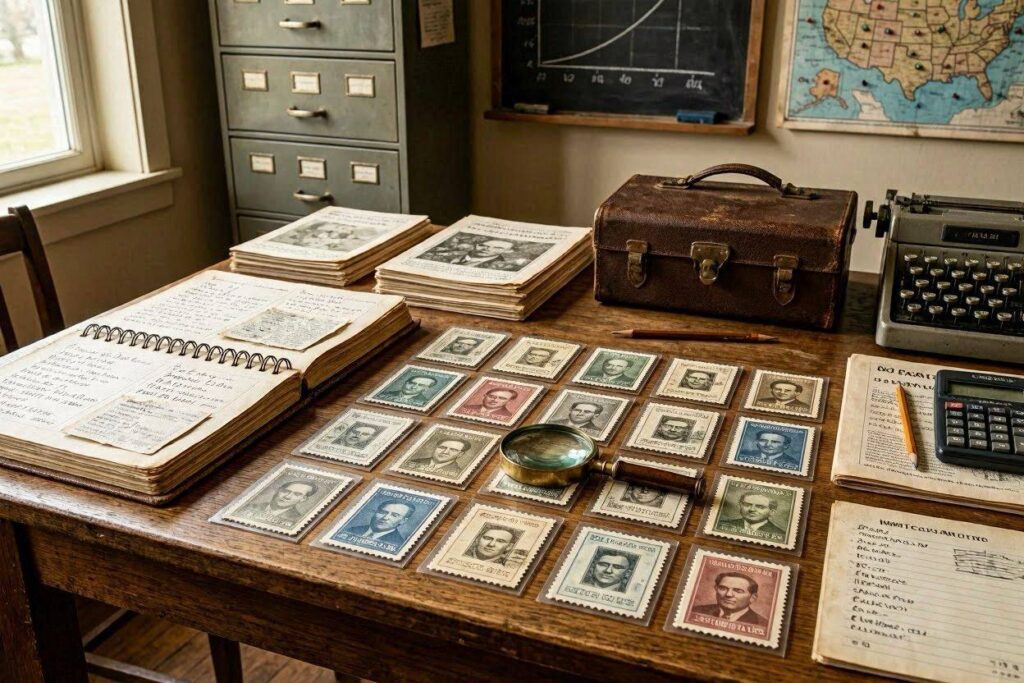
1. Breakdown of the Seven Cultural Categories
The series was meticulously structured. Each group contained five individuals, following a standardized color and denomination scheme: 1¢ (Green), 2¢ (Red), 3¢ (Purple), 5¢ (Blue), and 10¢ (Brown).
- Authors (January): Honored Washington Irving (1¢), James Fenimore Cooper (2¢), Ralph Waldo Emerson (3¢), Louisa May Alcott (5¢), and Samuel Clemens / Mark Twain (10¢).
- Poets (February): Featured Henry Wadsworth Longfellow (1¢), John Greenleaf Whittier (2¢), James Russell Lowell (3¢), Walt Whitman (5¢), and James Whitcomb Riley (10¢).
- Educators (March): Celebrated Horace Mann (1¢), Mark Hopkins (2¢), Charles W. Eliot (3¢), Frances E. Willard (5¢), and Booker T. Washington (10¢)—marking the first time an African American was featured on a U.S. postage stamp.
- Scientists (April): Included John James Audubon (1¢), Dr. Crawford W. Long (2¢), Luther Burbank (3¢), Dr. Walter Reed (5¢), and Jane Addams (10¢).
- Composers (May): Commemorated Stephen Collins Foster (1¢), John Philip Sousa (2¢), Victor Herbert (3¢), Edward A. MacDowell (5¢), and Ethelbert Nevin (10¢).
- Artists (September): Highlighted Gilbert Charles Stuart (1¢), James A. McNeill Whistler (2¢), Augustus Saint-Gaudens (3¢), Daniel Chester French (5¢), and Frederic Remington (10¢).
- Inventors (October): Featured Eli Whitney (1¢), Samuel F. B. Morse (2¢), Cyrus Hall McCormick (3¢), Elias Howe (5¢), and Alexander Graham Bell (10¢).
2. General Market Valuation of Mint vs. Used Singles
Because these stamps were heavily saved by collectors during the pre-war era, standard individual copies are generally inexpensive, but values diverge sharply based on condition.
- Standard Used Copies: Most 1¢ through 5¢ values hold minimal commercial value (often valued at the minimum catalog baseline of 20 to 25 cents). The 10¢ values face slightly higher demand but remain readily available for under a dollar in average used condition.
- Standard Mint Hinged (MH) Singles: A complete set of 35 mint, lightly hinged singles typically trades in the $15 to $25 range. The lower denominations are abundant, while the 10¢ values account for the bulk of the set’s cumulative value.
- Mint Never Hinged (MNH) Singles: True premium lies in pristine, unviolated gum. A complete set of 35 stamps in Mint Never Hinged condition with average centering generally commands between $30 and $50.
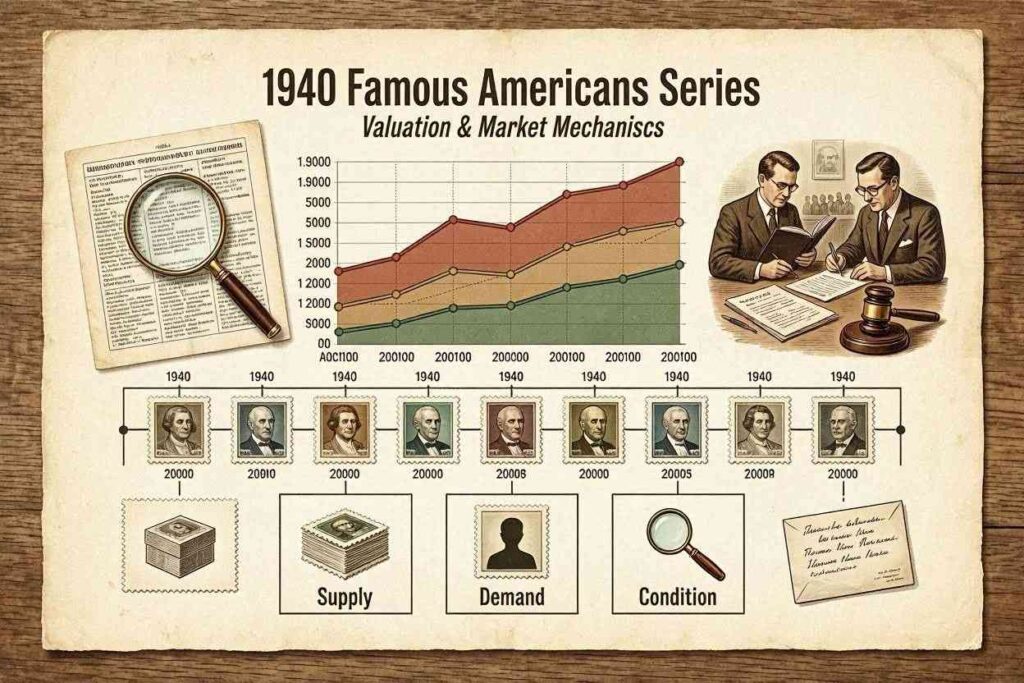
3. The Premium Variables: Centering, Grading, and Condition
The vast majority of the 1940 printings suffered from poor production alignment. The Bureau of Engraving and Printing utilized closely spaced perforations, which frequently cut into the frame designs.
- The Centering Multiplier: A stamp with standard “Fine-Very Fine (F-VF)” centering follows baseline catalog values. However, if a stamp achieves “Superb 98” or “Gem 100” centering—where the white margins are mathematically flawless on all four sides—the value skyrockets from a few dollars to upwards of $50 to $150 for a single 10¢ denomination.
- Gum Condition: Tropicalization, heavy hinging, or gum skipping dramatically degrades the asset. Pristine, smooth, original creamy gum from the 1940 press runs fetches the highest auction premiums.
- Perforation Integrity: The series was perforated 10½ x 11. Short perforations or pulled corners instantly disqualify these stamps from premium tier pricing.
4. High-Value Plate Blocks and Position Pieces
For advanced collectors of 20th-century U.S. issues, the real value of the Famous Americans series resides in intact plate number blocks.
- Four-Stamp Plate Blocks: Mint Never Hinged plate blocks (consisting of four stamps with the original margin showing the printing plate number) are highly sought after.
- The 10-Cent Denomination Premium: While a 1¢ plate block might only command $2 to $4, the 10¢ plate blocks (such as the Mark Twain, Booker T. Washington, or Alexander Graham Bell issues) are significantly scarcer. A pristine MNH 10¢ plate block routinely sells for $25 to $50+ each, depending on the specific figure and plate position.
- Complete Sheets: Intact, original post office panes of 50 stamps are rare survival pieces. Complete sheets of the 10¢ values can command hundreds of dollars at specialized philatelic auctions, driven by investors looking to break them down for high-grade singles.
5. Production Anomalies, Errors, and Varieties
While the 1940 series did not produce an error as famous as the Inverted Jenny, several distinct plate varieties and production anomalies keep specialists searching through bulk stocks.
- Double Transfers: Minor doubling of the engraved lines, caused by misalignment when the transfer roll pressed the image onto the steel printing plate, exists on several positions of the 10¢ Mark Twain and 5¢ Walt Whitman issues. These require magnification to verify but carry modest premiums from variety specialists.
- Electric Eye Marks: The margins of these sheets feature specific dashed lines and bars used by the electronic chopping machines of the era. Collectors specializing in “Electric Eye” formatting pay premiums for full margin strips showcasing these technical guides.
- Perforation Shifts: Drastic shifts where the horizontal or vertical perforations cut directly through the center of the historical figure’s face or nameplate turn a common stamp into a highly valued freak/error item.
6. Historical Postal History: Commercial vs. Philatelic Covers
The value of a stamp is not limited to its state off-paper. The postal history of the 1940 series provides a rich field for valuation variations.
- First Day Covers (FDCs): Because the series was highly publicized, thousands of First Day Covers were produced for each stamp, often featuring beautiful cachets (illustrated envelopes). Standard single-stamp FDCs are highly common, usually trading for $1 to $3.
- Combination FDCs: Covers that successfully combine all five members of a specific group (e.g., all five Inventors cancelled on their respective roll-out dates or locations) command much higher premiums.
- Solo Commercial Usages: Paradoxically, finding these stamps on ordinary, non-philatelic commercial mail is becoming increasingly difficult. A solo usage of the 10¢ Alexander Graham Bell stamp on a legitimate 1940 international airmail cover to Europe or South America is highly prized by postal historians and often commands a higher price than a pristine mint copy.
Quick-Reference Valuation Matrix for Key Issues
| Scott # | Honoree / Denomination | Mint Single (MNH) | Mint Plate Block (MNH) | Key Value Driver |
| 859 | 1¢ Washington Irving | $0.25 – $0.50 | $1.50 – $3.0 |