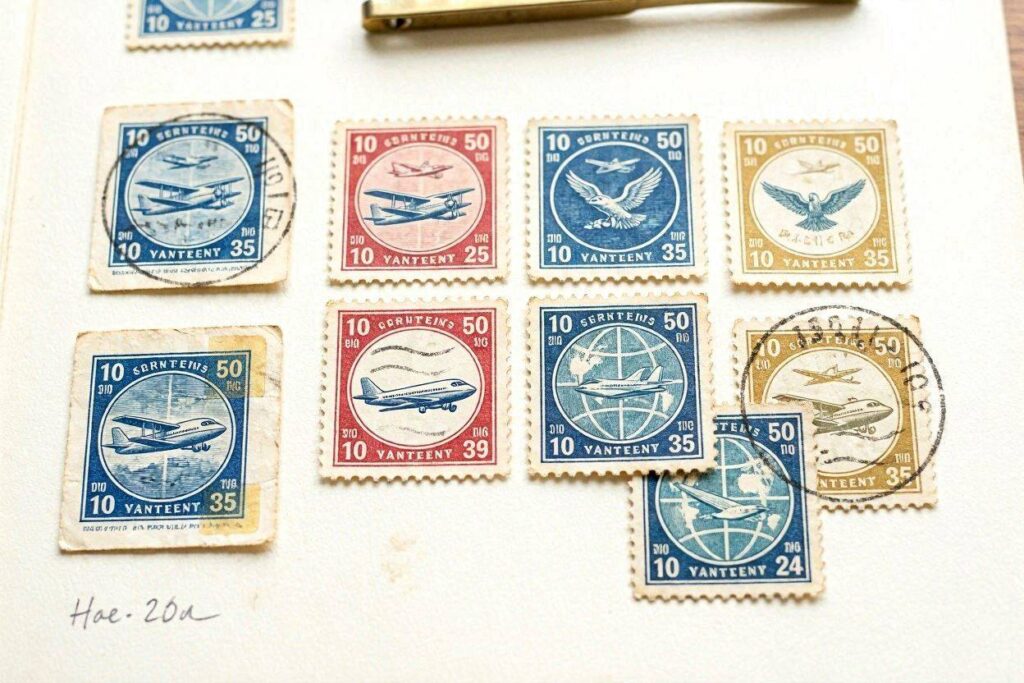
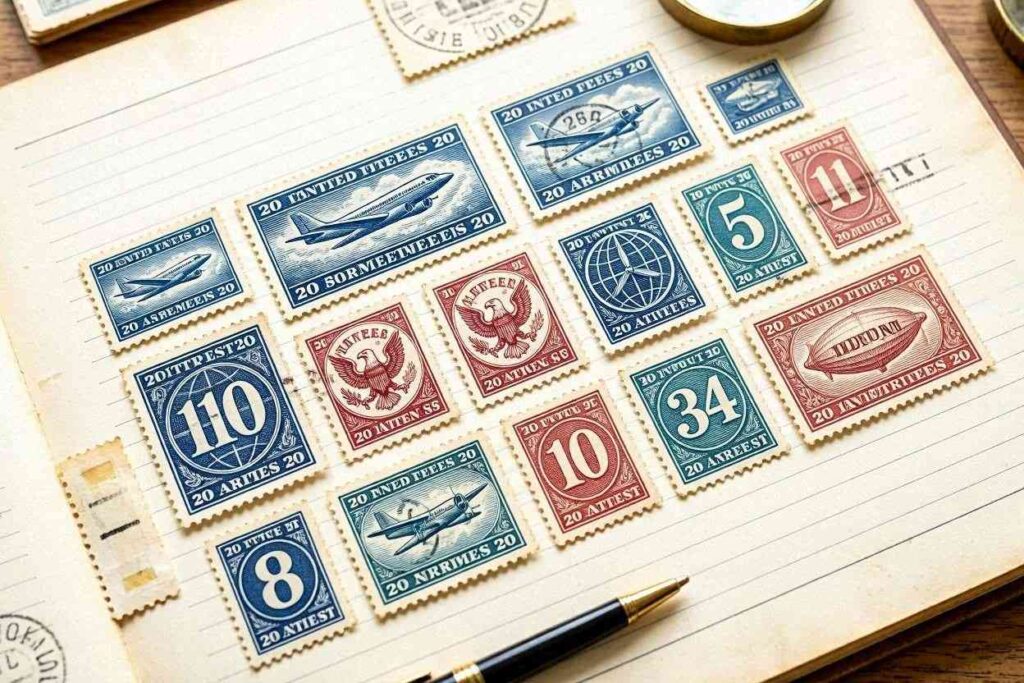
The Dawn of a New Era (1918): US Airmail stamps did not just carry letters; they funded the future of aviation. The Post Office Department introduced these specialized stamps to subsidize the high costs of early aerial mail routes, which were dangerous and experimental.
The First Scheduled Route: On May 15, 1918, the first regular airmail service was established between Washington, D.C., Philadelphia, and New York. This historic milestone required a distinct stamp to denote the premium 24-cent rate.
The Curtiss JN-4 “Jenny”: The iconic biplane chosen to grace the very first airmail stamp. This aircraft was a military trainer during World War I and became the face of early American aviation history.
Anatomy of the Famous 1918 “Inverted Jenny”
The Printing Process Error: The 24¢ Jenny stamp was printed using a two-color process—carmine rose for the frame and blue for the airplane. Because sheets had to be fed through the printing press twice, one sheet of 100 stamps was accidentally fed upside down.
William T. Robey’s Discovery: On May 14, 1918, a bank clerk named William T. Robey went to a Washington, D.C. post office and purchased the entire sheet of 100 inverted errors for exactly $24.00.
The Valuation Trajectory: Within days, Robey sold the sheet to a dealer for $15,000. Over the decades, the single stamps from this sheet became the holy grail of American collecting. In late 2023, a pristine single position of the Inverted Jenny shattered records by selling for over $2 million at auction.
Major Design Eras and Themes (1918–1950s)
The Early Pioneer Era (1918–1923)
The 1923 Map Series: As transcontinental routes expanded, the Post Office released a set of three stamps (8¢, 16¢, and 24¢) featuring the US airmail map and a silhouette of an airplane. These stamps represented the logistics required to fly mail across the country.
The Beacon and Winged Production (1928–1930)
The 1928 5¢ Beacon Stamp: Universally praised by designers, this bi-colored stamp shows the airmail beacon light on Sherman Hill in Wyoming. It highlighted the newly developed night-flying system that relied on giant ground-based searchlights.
The Winged Globe (1930): Moving away from specific planes, this design emphasized the global reach of aviation, featuring a stylized globe flanked by powerful eagle wings.
The Pan American Clipper Era (1935–1937)
Transpacific Conquest: To celebrate the massive Martin M-130 flying boats crossing the Pacific Ocean, the 25¢ blue Clipper stamp was issued. It features the flying boat soaring over San Francisco Bay, heading toward Hawaii and the Philippines.
Transatlantic Expansion (1939): A subsequent 30¢ blue stamp was issued to commemorate the opening of airmail service across the Atlantic to Europe.
Cult Classics: The 1930 Graf Zeppelin Series
+--------+---------------+------------------------------------------+
| Denom. | Color         | Depicted Scene                           |
+--------+---------------+------------------------------------------+
| 65¢    | Green         | Zeppelin flying East over the Atlantic   |
| $1.30  | Brown-Violet  | Zeppelin flying West between continents  |
| $2.60  | Blue          | Zeppelin hovering over the Globe         |
+--------+---------------+------------------------------------------+
The Historic Flight: Issued specifically for the European-Pan American round-trip flight of the German airship Graf Zeppelin in May 1930.
The Great Depression Crisis: Released during the depths of the economic crash, the face value of the full set ($4.55) was equivalent to a worker’s weekly wages. Consequently, very few sets were bought by the public.
The Destruction of Unsold Stock: Out of more than a million copies printed for each denomination, over 90% remained unsold. The Post Office destroyed the surplus stock, instantly turning the surviving Zeppelin stamps into scarce, highly sought-after collector pieces.
Grading, Condition, and Preservation Factors
Centering Standards: Vintage stamps are judged heavily on how perfectly the printed design is centered within the perforated borders. The categories range from Poor (design cut off by perforations) to Gem/Superb 100 (mathematically flawless borders).
Gum Quality (OG vs. LH vs. NH):
Never Hinged (NH): The original gum on the back is entirely pristine, untouched by paper hinges used in old albums.
Lightly Hinged (LH): The gum shows a faint mark where a hinge was once applied.
Original Gum (OG): The gum is present but may have disturbances, tropicalization, or heavy hinging.
Perforation Integrity: The small teeth around the edge must be clean, even, and complete. Pulled perforations or straight edges (from the margins of the sheet) significantly lower the market value.
Paper Condition and Toning: Early 20th-century paper is highly susceptible to humidity, sunlight, and acid from cheap album pages. Foxing (brown spots) or fading colors drastically reduce philatelic value.
Building a Strategic Collection Portfolio
The Conventional Complete Set Strategy: Many collectors focus on acquiring every single issue listed under the “C” prefix in the Scott Specialized Catalogue of United States Stamps (C1 through C150).
The “First Day Cover” (FDC) Angle: Collecting envelopes that were actually flown on the very first day a new airmail stamp was issued. These covers feature unique postal cancellations, cachets (illustrated artwork on the envelope), and historical signatures.
Plate Blocks and Strips: Instead of single stamps, serious philatelists often collect blocks of four or six stamps that include the original printing plate number in the margin. This adds an extra layer of rarity and printing history.
Common Counterfeits and Authentication Methods
Perforation Alterations: Dishonest sellers often take a cheaper “straight-edge” stamp and use specialized tools to punch fake perforations into it, trying to pass it off as a valuable, fully perforated variety.
Regumming Deception: Because “Never Hinged” stamps command huge price premiums, fraudsters apply modern synthetic glues to the back of used or hinged stamps to mimic pristine original gum.
The Importance of Certification: For any high-value US airmail stamp (especially the Jennies or Zeppelins), obtaining a certificate of authenticity from recognized authorities like the Philatelic Foundation (PF) or the American Philatelic Society (APS) is mandatory to verify genuine status before resale.