

Canadian postage stamps represent more than postal history; they are highly traded tangible assets in the global collectibles market. From pre-Confederation provincial releases to major 20th-century printing errors, rare Canadian stamps consistently command strong prices at international auctions.

Whether you have inherited a legacy stamp album or are building an investment-grade portfolio, knowing how to identify valuable issues and assess their condition is critical. This guide breaks down the market mechanics of rare Canadian stamps, key valuation criteria, and top investment-grade issues.
4 Crucial Indicators of a Valuable Canadian Stamp
The value of a Canadian stamp is determined by specific physical characteristics rather than age alone. Two stamps that look identical to an untrained eye can differ in value by thousands of dollars based on subtle distinctions.
1. Paper Type (Laid vs. Wove)
In early Canadian issues, the paper manufacturing process created distinct textures:
- Laid Paper: Features parallel lines embedded in the paper fiber, visible when held up to a light source.
- Wove Paper: Exhibits a uniform, smooth texture without visible internal line patterns.
Example: The 1868 2-Cent Large Queen printed on standard wove paper is worth a modest amount, whereas the rare variant printed on laid paper is valued at over $\$250,000$ due to its scarcity.
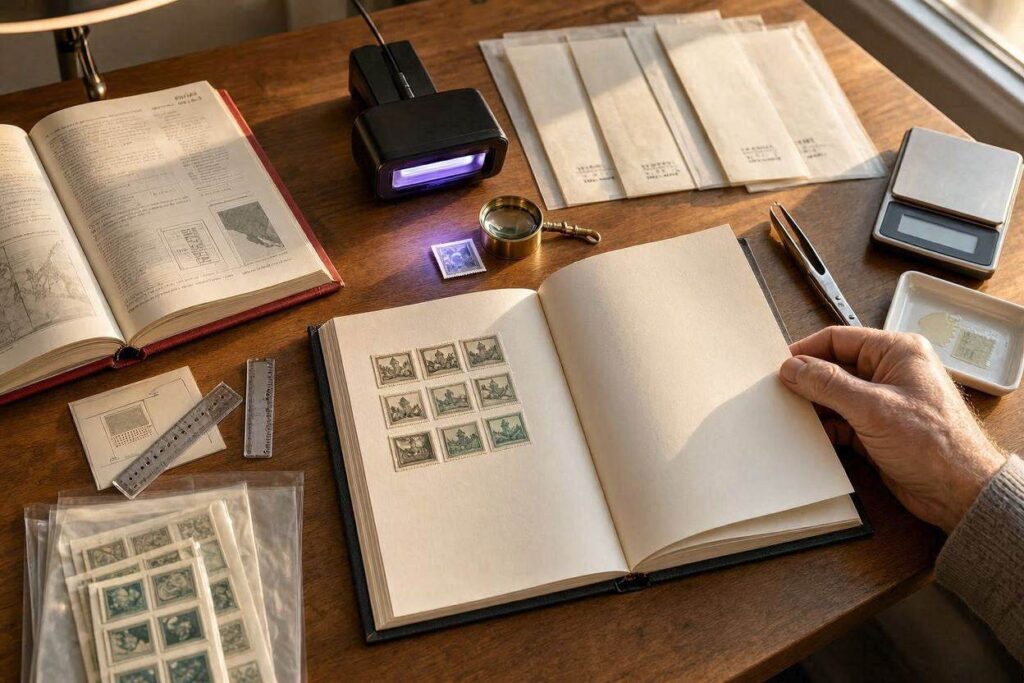
2. Perforations and Margins
Before 1858, Canadian stamps were imperforate, meaning postmasters cut them from sheets using scissors.
- Imperforate Stamps: Demand wide, uniform margins on all four sides. If a cut touches the design, the stamp’s value drops significantly.
- Perforated Stamps: Graded on centering. A stamp centered perfectly within its perforations earns top-tier pricing.
3. Gum Condition (Mint Never Hinged)
For unused stamps, the original adhesive backing (gum) plays a key role in valuation:
- MNH (Mint Never Hinged): The original gum is intact without marks or paper hinge remnants.
- MH (Mint Hinged): Shows evidence of a paper hinge used to mount the stamp into an album, reducing its valuation relative to MNH examples.
4. Known Printing Errors
Stamps containing production flaws—such as inverted centers, double transfers, or color omissions—are among the most sought-after philatelic items.
Top Investment-Grade Canadian Stamps
| Stamp Title | Issue Year | Key Distinguishing Feature | Estimated Market Value |
| 12d Black Queen Victoria | 1851 | Printed on laid paper; low mintage (1,450 sold) | $\$200,000 – \$500,000+$ |
| 2-Cent Large Queen (Laid Paper) | 1868 | Mistakenly printed on horizontally laid paper | $\$250,000 – \$1,000,000$ |
| St. Lawrence Seaway Invert | 1959 | Center design and text printed upside down | $\$12,000 – \$16,000$ |
| London to London Flight | 1927 | Overprinted 25c green/yellow issue | $\$50,000 – \$125,000$ |
| 50-Cent Bluenose | 1929 | High-grade engraving of the iconic schooner | $\$100 – \$3,000+$ (MNH) |
Specialized Niches in Canadian Philately
Investors and collectors often target specific sub-categories of Canadian postal history:
Pre-Confederation Provincial Issues
Before 1867, provinces maintained independent postal systems. Collecting stamps from Newfoundland, Nova Scotia, New Brunswick, and Prince Edward Island allows collectors to target finite, historically closed sets that cannot be expanded by modern releases.
Registered Letter Stamps (1875–1893)
Canada introduced specialized stamps explicitly for registered mail. Complete sheets or well-centered high-denomination registration stamps (such as the 8-cent value) represent rare, specialized philatelic holdings.
Plate Blocks and Margin Inscriptions
Collecting blocks of four or more stamps containing the printer’s edge inscription (plate numbers, manufacturer names, or color bars) carries a market premium over individual standalone stamps.
Step-by-Step: How to Authenticate and Sell a Collection
- Avoid Direct Handling: Always use smooth, flat-tip stamp tongs. Oils from skin damage paper fibers and degrade original gum backing.
- Consult Reference Catalogs: Cross-reference your stamps using the Unitrade Specialized Catalogue of Canadian Stamps to check catalog numbers, perforation gauges, and listed varieties.
- Get Expert Certificates: High-value Canadian rarities require authentication certificates from recognized bodies like the Vincent Graves Greene Philatelic Research Foundation or the Expert Committee of the Royal Philatelic Society London.
- Choose the Right Sales Channel: While common modern stamps can be sold via online marketplaces, rare or high-grade classical issues generally yield better realization rates through specialized philatelic auction houses.
Navigating the market for rare Canadian stamps requires careful attention to detail, paper varieties, and physical condition. By focusing on certified, high-grade classical issues and recognized errors, collectors and investors can build collections with enduring historical and monetary value.