

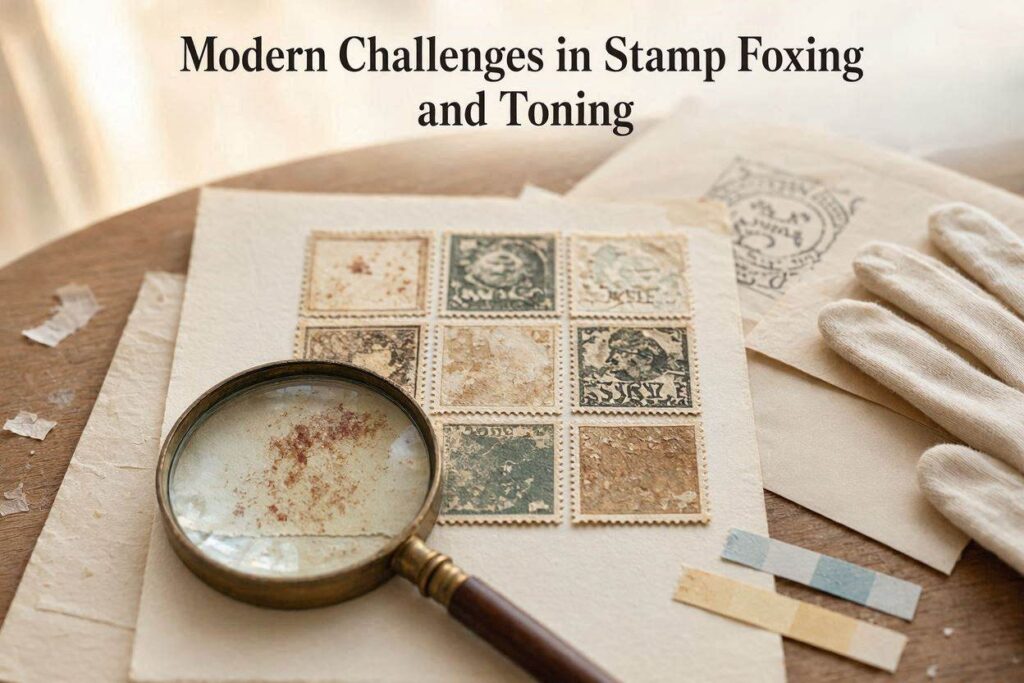
To a philatelist, a stamp is not merely a piece of paper; it is a historical artifact, a miniature work of art, and a financial investment. However, these delicate paper treasures are engaged in a quiet, perpetual battle against chemical and environmental decay. Among the most destructive and insidious of these threats are Foxing (the development of rusty brown spots) and Toning (the gradual yellowing or browning of the paper, particularly around the gummed back).
In the modern era, preserving stamps is no longer just about keeping them in a dry binder. Changing climates, advanced synthetic storage materials, and evolving chemical environments have introduced entirely new preservation hurdles. Below is a comprehensive, point-to-point analysis of the contemporary challenges surrounding stamp foxing and toning.
1. What is Foxing and Toning? (The Chemistry Behind the Decay)
Before tackling modern conservation hurdles, it is vital to understand what these phenomena actually are. They are not merely “dirt,” but complex chemical and biological processes.
- Foxing (Fungal vs. Inorganic): Foxing manifests as distinct, irregular reddish-brown spots. It is driven by two main culprits:
- Fungal activity: Micro-molds that feed on the sizing, starch, and nutrients in paper under humid conditions.
- Metal oxidation: Minute iron or copper impurities left over from the 19th and 20th-century paper manufacturing processes that rust when exposed to moisture.
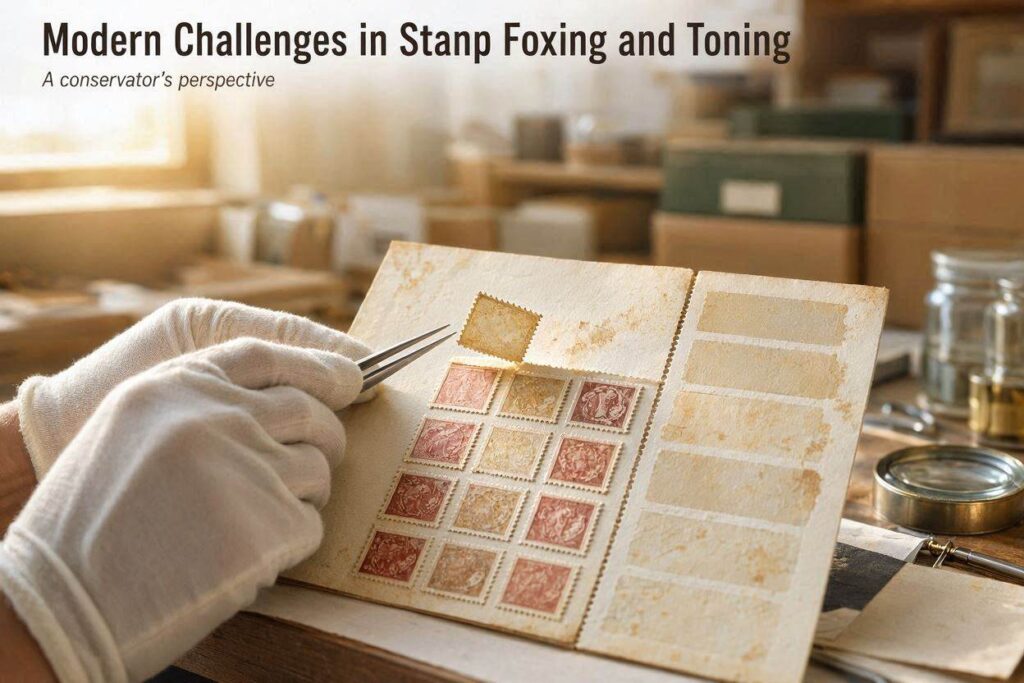
- Toning (Acidic Browning): Toning is the generalized yellowing or darkening of the stamp paper.
- It is primarily caused by acid migration from degraded adhesive gum (especially classic animal-based or tropicalized gums) or from contact with poor-quality, acidic album pages and glassine pockets.
2. The Modern Challenges of Stamp Foxing and Toning
With shifting global climates and new storage technologies, managing these degradation processes has become increasingly complex.
Challenge A: The “Micro-Climate” Volatility (Climate Change Impacts)
Traditional preservation manuals recommend static temperature and humidity levels. However, modern environmental shifts have made maintaining these baselines incredibly difficult.
- Extreme Humidity Spikes: Climate change has led to erratic weather patterns with sudden, intense humidity spikes. Mold spores responsible for biological foxing dormant for decades can suddenly activate within 48 hours of a humidity surge (above 60% Relative Humidity).
- The Micro-Climate Trap: When collectors use air conditioning to cool a room, they can inadvertently create localized condensation traps inside tightly sealed plastic stamp mounts, sealing moisture directly against the stamp gum and accelerating toning.
Challenge B: The Double-Edged Sword of Synthetic Storage Materials
In the past, stamps were mounted using paper hinges. Today, collectors use modern plastic mounts and stock pages. While they protect against physical handling, they introduce new chemical challenges.
- Plasticizer Off-Gassing: Cheap or uncertified plastic pockets (often containing PVC or unstable polymers) release volatile organic compounds (VOCs). These gases trap moisture and acids against the stamp, causing rapid, irreversible yellow toning.
- The Oxygen Deprivation Paradox: While sealing stamps in airtight plastic mounts prevents dust, it also traps acidic gases emitted by the stamp’s own aging paper and gum. Without air circulation, these trapped acids accelerate autocatalytic acid hydrolysis (toning).
Challenge C: The Dilemma of Classic Gum Preservation vs. Salvage
In stamp collecting, “Mint Never Hinged” (MNH) stamps with pristine, original gum command a massive premium. However, the original gum is often the very catalyst for the stamp’s destruction.
- The Gum Preservation Trap: Classic gum is highly acidic and hygroscopic (moisture-attracting). To preserve the stamp paper from toning and foxing, a conservator would ideally wash the gum off. However, doing so instantly destroys up to 80% of the stamp’s market value. Collectors are forced to choose between preserving the physical paper or preserving its financial value.
- Sulphur and Heavy Metal Reactivity: Many classic stamps were printed with metallic inks (such as lead-based pigments). The sulfur compounds in decaying gum react with these pigments, causing the colors to darken or “sulfurize” alongside general paper toning.
Challenge D: Scientific Detection and Forensic Grading
As the market for rare stamps grows, identifying, grading, and treating foxing has become a technical battlefield.
- Deceptive Restorations: Advanced, unethical sellers now use chemical bleaching agents (like hydrogen peroxide or sodium hypochlorite) to temporarily “erase” foxing and toning. However, these harsh chemicals weaken the paper fibers, causing the stamp to degrade and turn extremely brittle years down the line.
- The Need for Non-Destructive Testing (NDT): Modern collectors and auction houses struggle to detect hidden, chemically bleached foxing. Specialized equipment like UV-spectroscopy and infrared imaging is now required to verify if a clean-looking stamp has been chemically altered.
Challenge E: Bio-Resistance and Fungal Adaptation
The biological strains of mold that cause organic foxing are proving to be incredibly resilient.
- Resistant Fungal Strains: Over decades of pesticide and fungicide use in homes and archives, certain strains of Aspergillus and Penicillium (the fungi largely responsible for paper foxing) have developed resistances to traditional archival preservation vapors.
- Ineffectiveness of Gentle Drying: Simply drying a stamp out does not kill these spores; it merely sends them into dormancy. The moment humidity levels rise again, the foxing spots continue to expand.
Summary of Degradation Vectors
| Phenomenon | Primary Cause | Visual Indicator | Threat Level to Value | Modern Preventative Measure |
| Fungal Foxing | Active mold spores feeding on damp paper nutrients. | Fuzzy, circular brown or rusty spots. | High (ruins face design) | Humidistat-controlled rooms, maintaining <50% RH. |
| Inorganic Foxing | Oxidation of microscopic metal impurities in paper. | Hard-edged, dark reddish-brown spots. | High | Oxygen absorbers and acid-free archival storage. |
| Gum Toning | Acidic breakdown of original organic adhesives. | General yellowing, starting from the back/perforations. | Very High (destroys paper integrity) | Active carbon sheets, acid-free interleaving paper. |
| Chemical Bleaching | Unprofessional attempt to wash out foxing spots. | Unnatural stark whiteness, brittle paper texture. | Extreme (ruins physical stamp) |