

For generations of philatelists, the greatest threat to a collection was assumed to be external—a clumsy tear, water damage, or a hungry insect. However, modern paper chemistry has revealed a much more terrifying, internal threat: Paper Acidification. This is a process where the paper of vintage stamps literally consumes itself from the inside out.
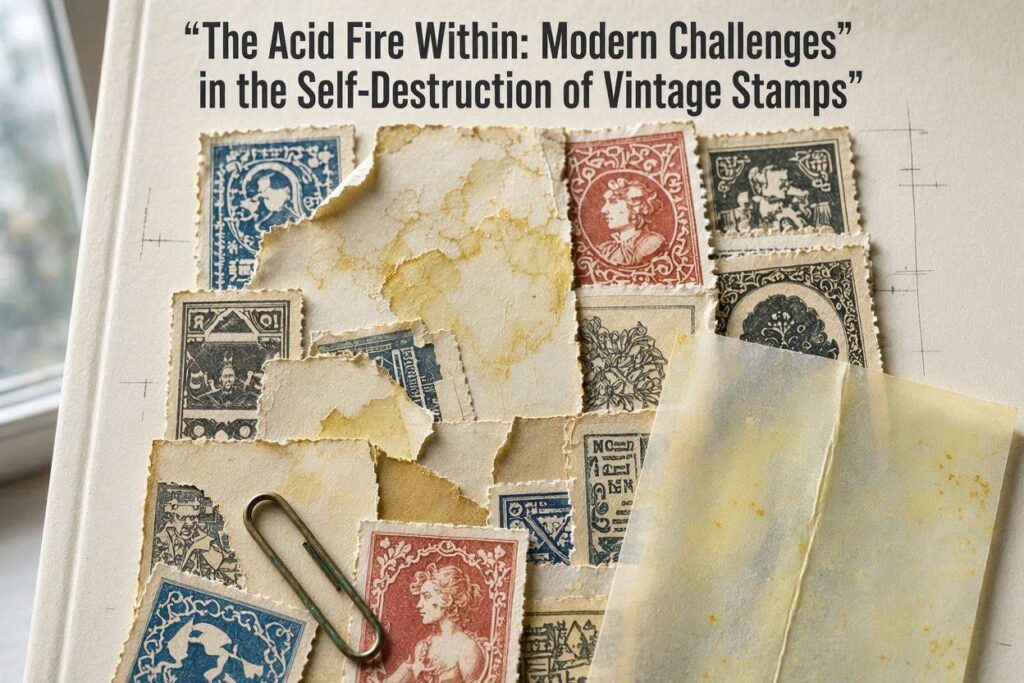
Commonly referred to in archival science as “slow fire,” acidification causes paper to turn yellow, lose its flexibility, become structurally brittle, and eventually split or shatter spontaneously at the slightest touch. As 19th- and 20th-century vintage stamps cross critical age thresholds, they are entering a phase of rapid, autocatalytic decay.
Keywords
- 👉 VINTAGE STAMPS 👈 (The core focus of historical paper preservation)
- Paper Acidification
- Acid Migration
- Cellulose Hydrolysis
- Alum-Rosin Sizing
- Autocatalytic Decay
- Lignin Breakdown
- Alkaline Buffering
- Gaseous Off-gassing
- Slow Fire
1. The Chemistry of Self-Destruction (Why Stamps Turn to Dust)
To understand why a stamp would spontaneously fracture, one must look at the industrial chemistry of the era in which vintage stamps were produced.
- The Alum-Rosin Trap: From the mid-19th century until the late 20th century, paper manufacturers used alum-rosin sizing to make paper less absorbent so inks wouldn’t bleed. Unfortunately, alum (aluminum sulfate) reacts with ambient moisture to produce sulfuric acid directly inside the paper fibers.
- The Lignin Time-Bomb: Early wood-pulp papers contained high amounts of lignin—an organic polymer that holds wood fibers together. Over time, exposure to light and oxygen causes lignin to break down into highly acidic compounds, accelerating the yellowing and weakening of the paper.
- Cellulose Hydrolysis: The structural backbone of paper is cellulose. Acids act as a catalyst for hydrolysis, breaking the long, strong polymer chains of cellulose into short, weak fragments. Once these chains are cut, the paper loses all tear resistance and becomes as brittle as dry autumn leaves.
2. Modern Challenges in Paper Acidification
Modern environmental factors, shifting storage tech, and chemical interactions have magnified this preservation crisis.
Challenge A: The Autocatalytic Acceleration Curve
Acidification is not a linear process; it is exponentially autocatalytic.
- Acid Breeds Acid: As the cellulose in vintage stamps degrades, the chemical reactions generate low-molecular-weight organic acids (such as formic and acetic acids) as byproducts.
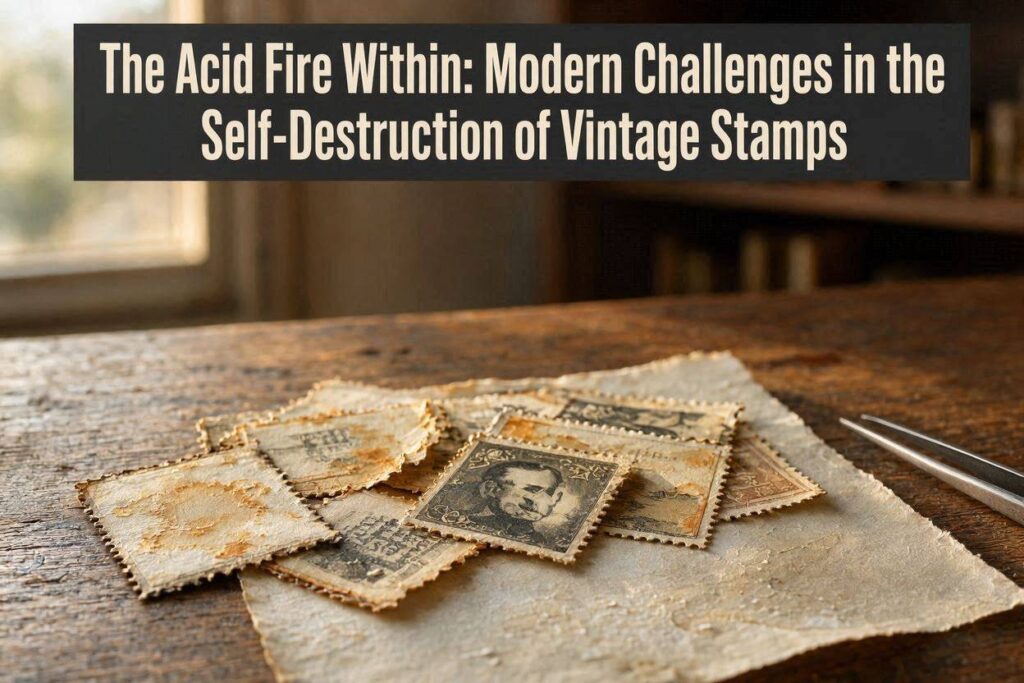
- The Runaway Reaction: These newly created acids lower the pH of the paper even further, accelerating the rate of the next round of decay. A stamp that appeared completely stable for 80 years can suddenly disintegrate into shards over the course of a single decade.
Challenge B: The Epidemic of “Acid Migration”
Acid is highly mobile. When an acidic material is placed next to a neutral material, the acid physically crawls from the area of high concentration to low concentration.
- The Album Page Poisoning: Many older, vintage stamp albums were manufactured using cheap, unbuffered wood-pulp cardstock. Over decades, the heavy acid load from these album pages migrates directly into the mounted vintage stamps, turning even high-quality rag paper stamps yellow and brittle.
- Hinge and Mount Contamination: Early adhesive hinges made of animal glues or acidic starches act as localized hubs of acid, causing localized dark brown spots and paper failure precisely where the hinge was applied.
Challenge C: The Sealed Microclimate Aggravation
While collectors seal valuable vintage stamps inside airtight polyester (Mylar) sleeves or safes to protect them from physical handling, this creates a dangerous chemical trap.
- Trapping Acidic Off-gassing: As acidic paper degrades, it releases volatile organic compounds (VOCs). In an open room, these gases dissipate safely. Inside a sealed plastic mount, these corrosive vapors are trapped.
- The Concentrated Acid Bath: The stamp is forced to sit in a concentrated microclimate of its own corrosive exhaust, drastically compounding the speed of paper fiber breakage.
Challenge D: Incompatibility of Deacidification with Classic Inks
In the broader archiving world, acidic documents are treated using liquid or gaseous alkaline buffers (like magnesium oxide or calcium hydroxide) to neutralize the acids. However, this presents a nightmare for philately.
- Soluble Ink Bleeding: Many classic vintage stamps were printed with highly sensitive, water-soluble, or chemical-soluble inks. Immersing a rare stamp in a liquid deacidification bath can cause the ink to run, instantly destroying its historical design and financial value.
- Chemical Discoloration: Certain historic pigments react violently to alkaline conditions. Introducing a calcium-rich buffer to neutralize acid might save the paper fibers but can cause the printed colors to chemically shift, turn black, or fade away.
Challenge E: Environmental Synergy (Humidity & Temperature as Accelerators)
Modern HVAC systems and changing climates create indoor humidity swings that feed the acidification monster.
- Water as a Reactant: Water is a core ingredient in the acid hydrolysis reaction. In humid environments (above 55% RH), the water molecules speed up the acid’s attack on the cellulose chains.
- The Heat Engine: High temperatures act as kinetic energy boosts for the chemical reaction. Stamps stored in warm attics or uncooled rooms experience exponentially faster fiber breakdown.
Degradation Summary: Acidification Vectors
| Culprit | Mechanism | Visual Manifestation on Stamp | Danger to Physical Integrity | Preventive Archival Strategy |
| Alum-Rosin Sizing | Reacts with moisture to create sulfuric acid. | Darkening of paper, brittle edges, spontaneous tearing. | Extreme (structural collapse) | Maintain stable RH ($45\%-50\%$), avoid dampness. |
| Lignin Oxidation | Light & oxygen break down wood-pulp fibers. | Harsh yellowing, dark browning of the paper. | High (paper embrittlement) | Dark storage; use UV-filtering glass/sleeves. |
| Acid Migration | Acid molecules transfer from acidic storage to stamp. | Outline of album page or hinge visible on stamp. | High | Store stamps exclusively on acid-free, buffered pages. |
| Volatile Trapping | Acidic off-gassing trapped in airtight plastic. | Accelerated, localized paper decay and fiber breakdown. | Extreme | Use highly breathable, active-scavenger interleaving sheets. |
The Archival Paradox:
“By sealing a stamp away to protect it from the outside world, we often seal it inside a microscopic pressure cooker of its own self-generated acids, accelerating the very destruction we sought to prevent.”
The Path Forward: Passive Neutralization
To save vintage stamps from the destructive cycle of paper acidification without risking damage to historic inks, the modern philatelic community must adopt passive neutralization techniques:
- Deploy Zeolite and Carbon Scavengers: Utilize advanced, specialized archival interleaving sheets (like MicroChamber paper). These contain active molecular sieves (zeolites) that chemically attract and permanently trap both moisture and volatile acidic off-gassings before they can damage the stamp fibers.
- Ensure Acid-Free, Buffered Mounts: Only use certified lignin-free, acid-free storage systems with an alkaline reserve (often calcium carbonate) to absorb migrating acids.
- Strict Microclimate Stabilization: Keep the storage environment cool ($15^\circ\text{C}-20^\circ\text{C}$) and dry ($40\%-45\%$ RH) to slow down the chemical kinetics of cellulose hydrolysis.