

To the untrained eye, a stamp stored safely inside an album or a drawer is protected from the elements. But to a materials scientist or a serious philatelist, that stamp is trapped in a volatile battleground. Micro-Environmental Degradation—the localized physical and chemical deterioration of paper, ink, and gum caused by minute fluctuations in ambient humidity, temperature, and air quality—is the silent killer of vintage stamps.
In an era of shifting global climates, urban air pollution, and micro-climatic shifts within modern homes, traditional “dry place” storage advice is no longer enough. The pocket of air surrounding a stamp can become a highly destructive micro-reactor.
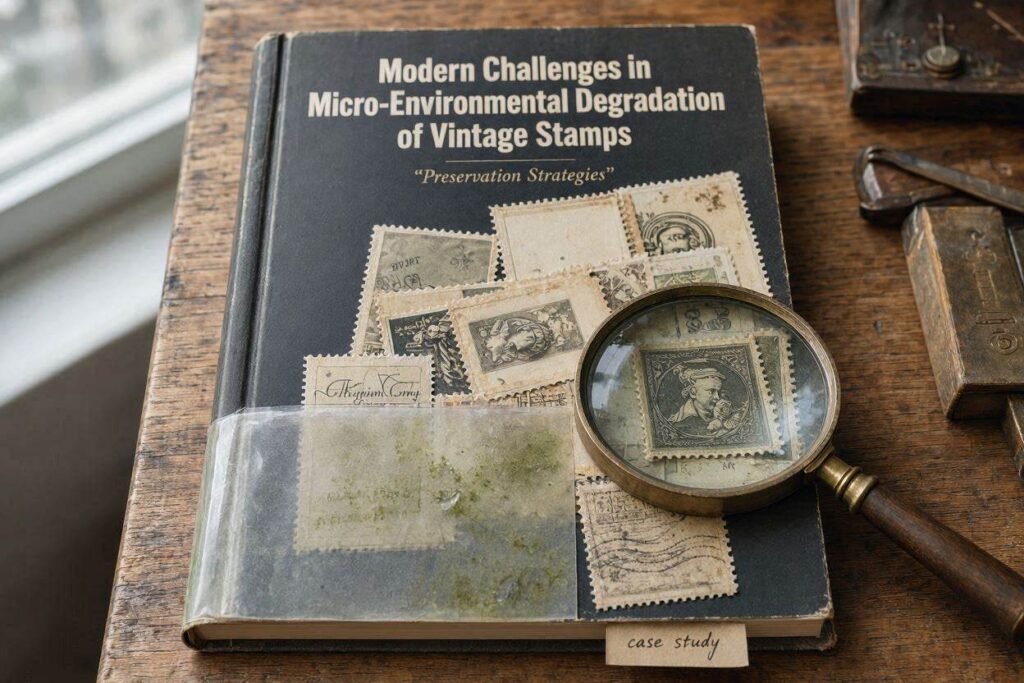
Below is a detailed, point-to-point breakdown of the cutting-edge challenges posed by micro-environmental degradation to vintage stamps.
Keywords
Vintage Stamps, Micro-Environmental Degradation, Relative Humidity (RH) Fluctuations, Thermal Desorption, Hysteresis Loop, Micro-Climate Trapping, Atmospheric Pollutants, Acid Migration, Hygroscopic Expansion.
1. Defining the Micro-Environment (The “Micro-Pocket” Trap)
Before examining the challenges, we must define the micro-environment. A stamp’s true environment is not the room it sits in, but the micro-pocket of air directly contacting the stamp inside its mount, album page, or protective sleeve.
- Hygroscopic Warfare: Vintage stamps are composed of organic materials (cellulose paper, organic inks, and natural gums) that are highly hygroscopic—meaning they continuously absorb and release moisture from this micro-pocket to match the surrounding air.
- The Thermal Catalyst: Temperature acts as an accelerator. Every $10^\circ\text{C}$ ($18^\circ\text{F}$) increase in temperature roughly doubles the rate of chemical reactions, rapidly escalating the speed at which moisture and acids destroy the paper fibers.
2. Modern Challenges of Micro-Environmental Degradation
Modern lifestyle shifts, housing construction, and climate volatility have introduced entirely new threats to the micro-environments of vintage stamps.
Challenge A: The Micro-Climate “Greenhouse Effect” of Plastic Mounts
Modern collectors widely use synthetic, “acid-free” plastic mounts (such as Mylar or polystyrene) to protect individual vintage stamps. However, these mounts can act as microscopic greenhouses.
- The Condensation Trap: If a stamp is mounted in a room with high humidity and the room is suddenly cooled (e.g., turning on air conditioning), the temperature drops faster than the moisture can escape the plastic sleeve. This causes micro-condensation to form on the inside of the mount, directly soaking the stamp.
- Volatile Accumulation: When paper and older adhesives age, they naturally release volatile organic acids. In a sealed plastic mount, these gases cannot escape. The stamp is forced to sit in a concentrated cloud of its own acidic off-gassing, causing rapid paper yellowing (toning) and brittle edges.
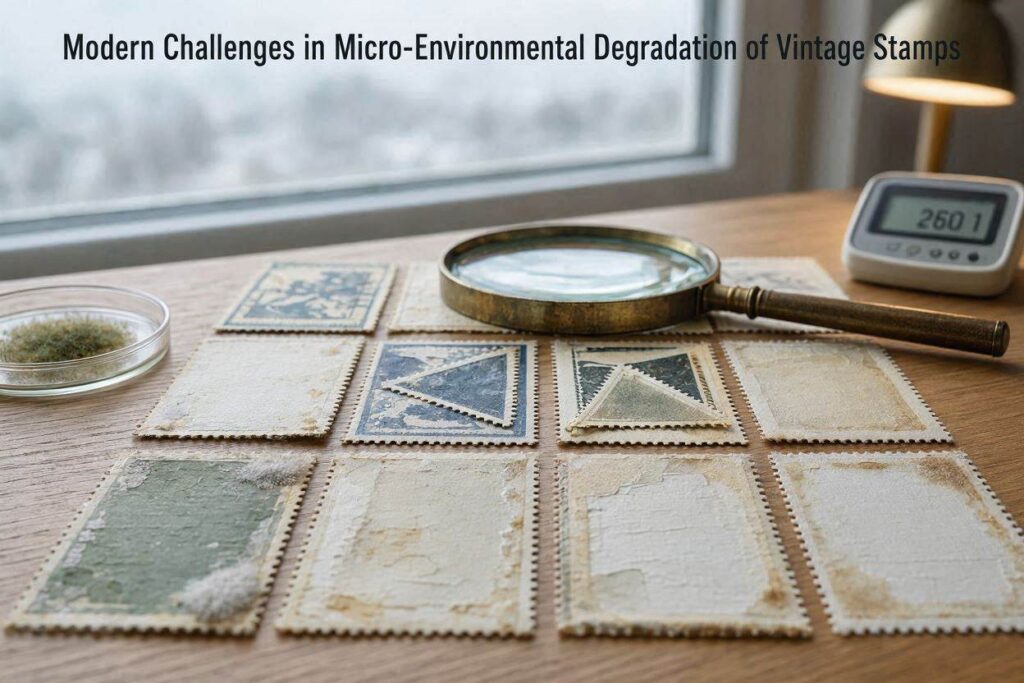
Challenge B: The “Hysteresis Loop” and Cellulose Fatigue
Relative Humidity (RH) is never static. In modern homes, heating and cooling cycles cause RH to swing up and down daily.
- Continuous Stress Cycling: When RH rises, the paper fibers of vintage stamps swell (hygroscopic expansion). When RH falls, they contract. This constant back-and-forth is known as the hysteresis loop.
- Structural Micro-Fracturing: Over time, this constant physical breathing causes mechanical fatigue at the cellular level of the paper. The fibers loosen, causing the stamp to warp, curl permanently, or develop microscopic tears along the fragile perforations.

Challenge C: The Urban Pollutant Synergy
Modern urban air is loaded with invisible chemical agents—such as sulfur dioxide ($SO_2$), nitrogen oxides ($NO_x$), and ground-level ozone ($O_3$)—that penetrate even closed albums.
- The Acid Rain Effect: When moisture in the air (humidity) mixes with sulfur dioxide inside a stamp album, it forms trace amounts of sulfuric acid. This acid directly attacks the cellulose molecules of vintage stamps, leading to rapid acid rot.
- Color Fading and Alteration: Many classic stamps were printed using natural, organic dyestuffs or metallic pigments (like lead carbonate). When exposed to micro-environmental pollutants and humidity, these colors can chemically shift. For example, vibrant orange and red lead-based stamps can turn a dark, metallic black.
Challenge D: HVAC and Smart Home Micro-Dryness (Over-Desiccation)
While moisture is a known enemy, the modern trend of tightly insulated homes and heavy HVAC (Heating, Ventilation, and Air Conditioning) usage has created an opposite, equally dangerous threat.
- The Desiccation Danger: In winter, central heating can drop indoor relative humidity to below $25\%$. This extreme dryness pulls the essential structural water out of the stamp’s paper and organic gum.
- The Irreversible Glass State: When vintage stamps are over-desiccated, their gum undergoes adhesive crystallization, turning into a brittle, glass-like crust that can crack, taking the stamp paper with it at the slightest movement.
Challenge E: Micro-Biological Colonization (Mold and Foxing)
High humidity combined with warm micro-temperatures creates the perfect incubator for microscopic life.
- The Dormant Spore Activation: Fungal spores are everywhere, resting dormant on almost all vintage stamps. The moment the micro-environmental humidity crosses $60\%$ RH and temperatures exceed $22^\circ\text{C}$ ($71.6^\circ\text{F}$), these spores germinate.
- Fungal Digestion: Active fungi feed on the sizing, starch, and gelatin on the stamp. This metabolic process leaves behind the permanent, ugly rusty-brown spots known as foxing.
Comparative Degradation Chart: Micro-Environmental Vectors
| Micro-Environmental Vector | Critical Threshold | Physical Impact on Vintage Stamps | Primary Chemical Reaction | Modern Defense Strategy |
| High Relative Humidity | $> 60\%$ RH | Paper swelling, warping, limp paper texture, gum sticking. | Hydrolysis, fungal germination (foxing). | Dehumidifiers, silica gel packets in safes. |
| Low Relative Humidity | $< 35\%$ RH | Extreme paper brittleness, curling, perforation cracking. | Adhesive crystallization, desiccation. | Humidistat-controlled rooms, avoiding direct HVAC draft. |
| Thermal Spikes | $> 25^\circ\text{C}$ ($77^\circ\text{F}$) | Gum softening, accelerated aging. | Kinetic acceleration of acid migration. | Cold storage or stable climate-controlled archiving. |
| Gaseous Pollutants | Elevated $SO_2$/$NO_x$ | Pigment darkening, paper yellowing. | Sulfuric acid formation, oxidation of metallic inks. |