

For collectors of vintage stamps, the ultimate mark of quality lies not just in the central image, but on the very edges of the paper. The tiny teeth and semi-circular valleys that border a stamp—known as perforations—are more than just a functional method for separating sheets; they are a defining characteristic of classic philately.
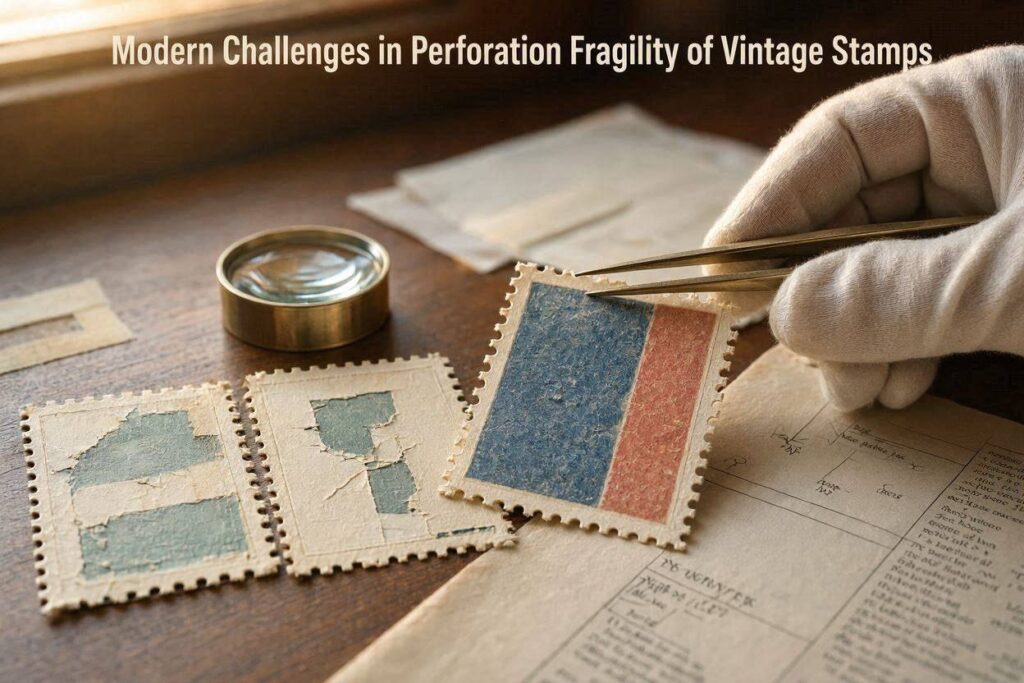
However, these delicate paper teeth are the most structurally vulnerable part of any stamp. Perforation Fragility (the weakening, fraying, and snapping of stamp edges) is an escalating threat. As the paper of vintage stamps crosses the century mark, the mechanical and environmental stresses of the modern world are causing these fragile margins to fail at an alarming rate.
Keywords
- VINTAGE STAMPS (Highlighting the ultimate focus of philatelic preservation)
- Perforation Fragility
- Tensile Strength Decay
- Paper Tear Resistance
- Micro-Mechanical Stress
- Electrostatic Pull
- Re-perforation Fraud
- Hygroscopic Expansion Fatigue
- Friction Wear
1. The Anatomy of Perforation Weakness (Why the Edges Fail First)
To understand the modern challenges, we must first look at the structural physics of a stamp’s border.
- The Stress-Concentration Effect: When sheets of vintage stamps were originally produced, machines punched holes into the paper. This process crushed and tore the local cellulose fibers at the micro-level, creating built-in weak points along the edge of every stamp.
- Fiber Exposure: Unlike the sealed, cut edges of modern die-cut self-adhesive stamps, classic perforated edges expose raw, open-ended paper fibers directly to the air. This makes the perforations highly susceptible to dirt, acid absorption, and moisture.
2. Modern Challenges in Perforation Fragility
Preserving these delicate borders has become increasingly difficult due to modern storage habits, global transit risks, and advanced forgery techniques.
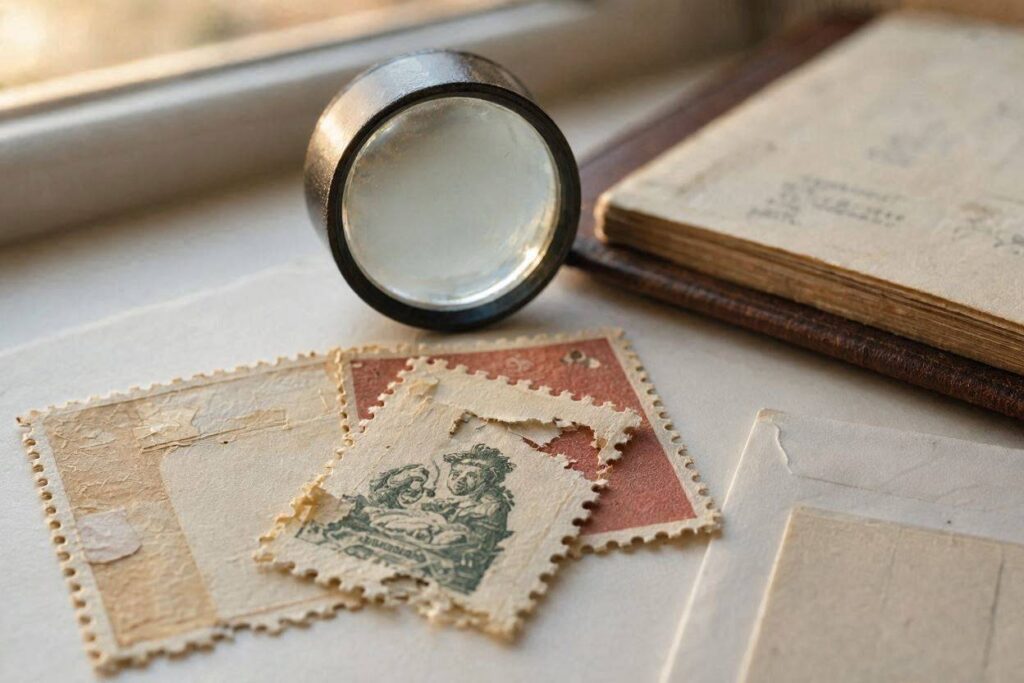
Challenge A: The “Static Snag” of Modern Polymer Mounts
Modern collectors heavily rely on synthetic protective mounts (such as Mylar, polyester, or polystyrene sleeves). While they shield stamps from dust, they introduce a hidden mechanical threat.
- Electrostatic Charge: Slide a stamp into a tight plastic mount, and friction generates static electricity. The thin, delicate paper teeth of vintage stamps can cling to the plastic sleeve due to this electrostatic charge.
- The Extraction Tear: When a collector attempts to slide the stamp out of the mount using tweezers, the static grip holds the perforation teeth back. The resulting shear force is often enough to snap off a corner tooth or split a perforation line.
Challenge B: High-Vibration Global E-Commerce Transit
The rise of online auction platforms has turned vintage stamps into global travelers. Stamps are frequently shipped across continents, exposing them to physical forces their original creators never anticipated.
- Harmonic Vibrations: During transit in cargo planes and postal trucks, envelopes are subjected to constant micro-vibrations. If a stamp is not securely locked in place within its shipping package, these vibrations cause the stamp to slide back and forth.
- Frictional Erosion: The delicate edges rub against the inside of the glassine or plastic pocket, slowly wearing down the paper fibers and turning crisp, sharp perforation tips into rounded, fuzzy nubs.
Challenge C: The Creeping Tension of Crystallizing Gum
The adhesive on the back of a stamp does not age gracefully. As 19th-century organic gums (like gum arabic) dry out, they undergo a phase change called adhesive crystallization.
- The Boundary Pull: When gum crystallizes, it shrinks and curls. Because the gum layer extends all the way to the edge of the stamp, this shrinkage exerts a continuous outward pull on the perforation teeth.
- Spontaneous Splitting: Under this constant, dry tension, any minor bump or change in air pressure can cause the brittle paper between the perforation holes to fracture spontaneously.
Challenge D: Re-perforation Fraud and Detection Crises
As pristine vintage stamps with perfect margins skyrocket in value, unethical restorers have developed highly sophisticated methods to “repair” damaged perforations or fake rare perforation gauges.
- The “Franken-Stamp” Threat: Fraudsters use laser cutters and fiber-bonding adhesives to add healthy margins or rebuild missing perforation teeth onto damaged stamps.
- The Verification Dilemma: Philatelic experts must now use advanced digital microscopy and spectral analysis to distinguish between an authentic, naturally aged perforation and a chemically stabilized, laser-cut fake.
Challenge E: Environmental Humidity Swings (The Accordion Effect)
Modern homes fluctuate wildly in temperature and humidity due to intermittent HVAC usage. This creates a destructive physical cycle at the stamp’s edges.
- Differential Swelling: The dense center of the stamp absorbs and releases moisture at a different rate than the thin, hole-punched perforations.
- Mechanical Fatigue: As the edges expand and contract faster than the core body, a shearing stress develops along the perforation line. Over time, this “accordion effect” weakens the paper fibers, making them so soft they crumble when touched.
Comparative Matrix: Perforation Damage Vectors
| Damage Type | Primary Cause | Visual Warning Signs | Risk to Stamp Value | Modern Prevention Method |
| Split Perforation | Tension from dry, contracting gum; rough handling. | A clean rip connecting two perforation holes. | Medium to High | Keep RH strictly between $45\%\text{ and }52\%$ to prevent gum contraction. |
| Pulled Tooth | Static cling in plastic mounts; poor tweezer grip. | A missing paper tip, leaving a flat, torn edge. | Very High | Use anti-static archival mounts; always handle using flat-tip philatelic tweezers. |
| Fuzzy Perforations | Friction against rough paper or poor-quality pockets. | Soft, rounded, fiber-heavy perforation tips. | Medium | Use secure, non-slip pocket layouts during transit. |
| Re-perforated Border | Unethical alteration to mimic a rare perforation gauge. | Unnaturally sharp, clean holes; mismatched paper fibers under UV. | Complete loss of authenticity | Forensic UV and back-light inspection before buying. |
The Custodian’s Truth:
“The beauty of a classic stamp is held together by its holes. When we fail to protect the spaces between the paper, we lose the integrity of the entire artifact.”
The Path Forward: Safeguarding the Edges
To combat the escalating threat of perforation fragility in vintage stamps, collectors and dealers must update their handling and preservation standards:
- Switch to Anti-Static Archival Materials: Ensure all protective sleeves are rated as static-dissipative. When removing a highly valuable stamp, gently split the sides of a disposable pocket rather than sliding the stamp out and risking a snag.
- Pressure-Stabilized Storage: Store vulnerable stamps flat under light, uniform pressure. This physically prevents the stamp from curling, neutralizing the tension exerted by old, contracting adhesive on the perforation teeth.
- Vibration-Dampened Shipping: When mailing stamps, sandwich them tightly between two rigid, acid-free cards and seal them inside a waterproof, vacuum-closed bag. This completely eliminates sliding and friction during transit.