

When it comes to early British North American philately, few topics generate as much excitement—and confusion—as paper varieties. For collectors and investors evaluating the iconic 1851 Province of Canada issue, distinguishing between laid paper and wove paper is not just an academic exercise; it is a distinction that can mean a difference of thousands of dollars in market valuation.
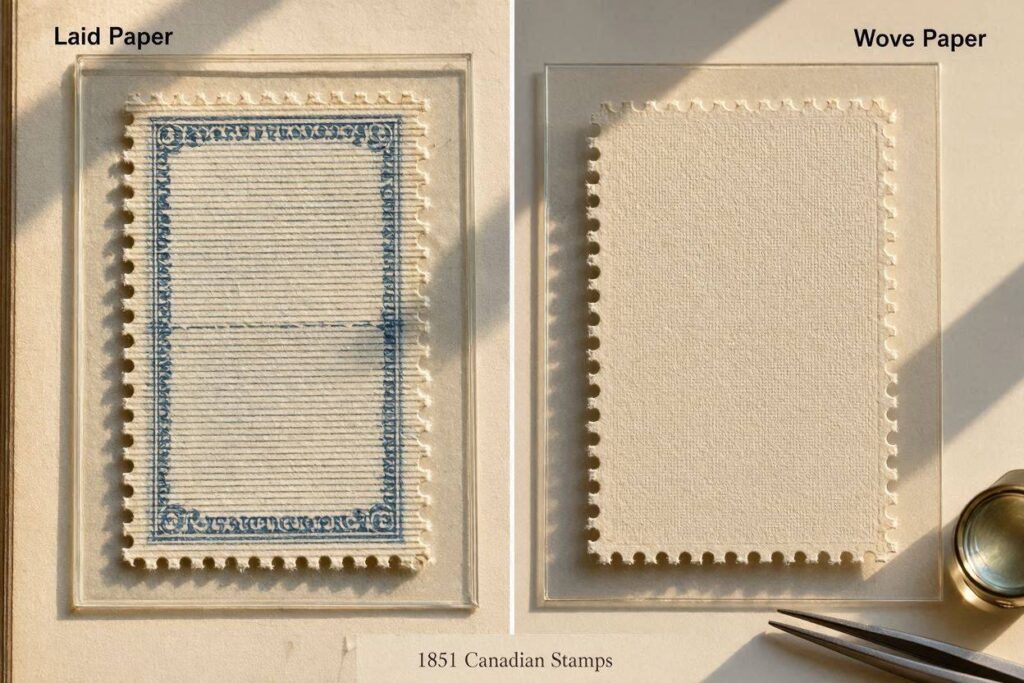
The 1851 issue includes historic milestones such as the famous 3d Beaver (designed by Sir Sandford Fleming), the 6d Prince Albert, and the legendary 12d Black Queen Victoria. While all three designs are highly sought after, their paper structure plays a definitive role in their rarity, cataloging, and market price.
In this comprehensive identification guide, we break down the physical characteristics, manufacturing history, testing techniques, and valuation differences between laid paper and wove paper on 1851 Canadian stamps.
The Historical Background: How 1851 Canadian Stamp Papers Were Made
To accurately identify paper varieties, it helps to understand how paper was produced in the mid-19th century. During this era, paper was manufactured using wire molds, and the mechanical texture of these molds transferred directly onto the damp paper pulp as it dried.
+-----------------------------------------------------------------------+
|                       PAPER MANUFACTURING TYPES                       |
+----------------------------------+------------------------------------+
|            LAID PAPER            |             WOVE PAPER             |
+----------------------------------+------------------------------------+
| Created using a mold made of     | Created using a finely woven       |
| parallel wires crossed by wider  | wire mesh screen (similar to a     |
| chain wires.                     | window screen).                    |
|                                  |                                    |
| Result: Parallel lines embedded  | Result: Smooth, uniform texture    |
| directly into the paper fiber.   | without visible lines.             |
+----------------------------------+------------------------------------+
The initial order of stamps printed by Rawdon, Wright, Hatch & Edson (the New York banknote engraving firm contracted by Canada in 1851) utilized handmade laid paper. Later printings transitioned to wove paper, which provided a more uniform surface for fine steel engraved printing.
1. Laid Paper: Characteristics and Identification
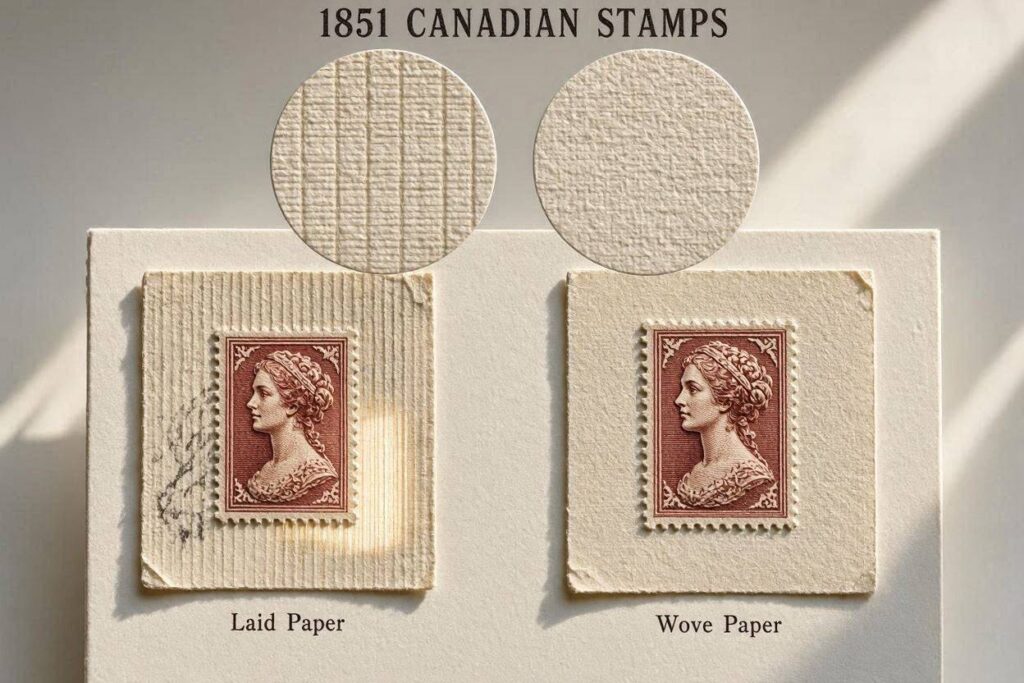
Laid paper is the hallmark of the very first 1851 printings. Because it was made on traditional wire molds, the paper structure retains parallel lines running throughout the sheet.
Key Visual & Physical Features:
- Laid Lines: Visible parallel lines running either horizontally or vertically across the stamp.
- Chain Lines: Wider-spaced lines running perpendicular to the laid lines (often harder to see on a single stamp due to their wide spacing).
- Paper Texture: Slightly uneven thickness when viewed with backlighting; often feels slightly crisp or ribbed.
Orientation on 1851 Issues:
- 3d Beaver (Scott #1): Printed on verbatim laid paper with lines running transversely (horizontally) across the stamp design.
- 6d Prince Albert (Scott #2): Printed on laid paper with lines running vertically.
- 12d Black Queen Victoria (Scott #3): Printed on handmade laid paper with lines running vertically.
2. Wove Paper: Characteristics and Identification
Wove paper replaced laid paper in subsequent printings starting around late 1851 and 1852. The manufacturing process used a woven wire cloth, resulting in a smooth, continuous surface without directional line patterns.
Key Visual & Physical Features:
- Uniform Structure: Smooth texture under magnification with no parallel lines.
- Mottled / Screened Appearance: When backlit, wove paper shows a fine, mesh-like or “flecked” pattern without directional bias.
- Varying Thickness: Early Canadian wove papers range from thin transparent wove to thick, opaque handmade wove stock.
Examples in the 1851–1855 Issues:
- 3d Beaver (Scott #4): Printed on various types of wove paper (thin, medium, hard, and soft wove stock).
- 6d Prince Albert (Scott #5): Issued on soft, medium, and thick wove papers.
Step-by-Step Methods to Test Laid vs. Wove Paper
Accurately determining paper type requires safe, non-destructive testing methods. Here is how professional philatelists and expertizing committees verify paper structure:
Method 1: The Backlighting / Transmitted Light Test
- Place the stamp face-down on a clean, soft surface using stamp tongs.
- Direct a bright, diffused light source behind the stamp (or hold it carefully over a lightbox).
- What to look for:
- If you see distinct, evenly spaced parallel dark and light lines running across the paper fiber, it is laid paper.
- If the paper looks uniformly grainy, mottled, or smooth without parallel lines, it is wove paper.
Method 2: The Watermark / Fluid Tray Test
- Place the stamp face-down in a clean black watermark tray.
- Apply a few drops of approved, non-toxic philatelic watermark fluid.
- Observe the paper as it saturates.
- What to look for: The fluid highlights variations in paper density. Laid lines will immediately stand out as alternating light and dark bands, whereas wove paper maintains an even shade across the surface.
Caution: Never bend or flex a 1851 classic stamp to check for paper texture. Flexing old paper fibers can cause micro-creases, instantly destroying up to 80% of the stamp’s market value.
Market Valuation & Rare Varieties: Laid vs. Wove
The difference between laid and wove paper directly dictates catalog numbers, rarity, and monetary valuation in major references like the Unitrade Specialized Catalogue of Canadian Stamps and the Scott Standard Postage Stamp Catalogue.
| Stamp Design | Face Value | Laid Paper Catalog # | Wove Paper Catalog # | Value Difference (Approx. Fine-Very Fine) |
| Beaver | 3d | Scott #1 (Laid) | Scott #4 (Wove) | Laid: $\$1,000 – \$5,000+$ Wove: $\$200 – \$1,200$ |
| Prince Albert | 6d | Scott #2 (Laid) | Scott #5 (Wove) | Laid: $\$2,000 – \$10,000+$ Wove: $\$500 – \$3,000$ |
| Queen Victoria | 12d | Scott #3 (Laid) | N/A (Extremely Rare) | Laid: $\$200,000 – \$500,000+$ (Wove varieties are trial color proofs/rare) |
Why the Price Gap Is So Large:
- Print Run Scarcity: Laid paper printings represent the first, smallest batches shipped to Canadian post offices in April 1851.
- Survival Rates: Fewer laid paper stamps survived in high-grade condition due to early postal destruction and natural paper degradation.
- Collector Demand: Complete “Pence Issue” sets on laid paper are considered pinnacle holdings in world-class classical collections.
Key Takeaways for Collectors & Buyers
When collecting or investing in 1851 Canadian classics:
- Always verify orientation: On the 3d Beaver, laid lines run horizontally; on the 6d and 12d, laid lines run vertically.
- Beware of false lines: Ink wiping marks or heavy canceling ink can sometimes simulate parallel lines. Always inspect the paper structure using transmitted light rather than looking solely at the printed surface.
- Obtain Expert Certificates: High-value laid paper issues (especially Scott #1, #2, and #3) should always be accompanied by a certificate of authenticity from a recognized expertizing body, such as the Vincent Graves Greene Philatelic Research Foundation or the RPSL (Royal Philatelic Society London).
By mastering the distinction between laid and wove paper, you can confidently evaluate early Canadian pence issues, spot misidentified varieties, and make informed decisions in the classical philatelic market.