

In public finance and global logistics, Postal Deficit Amplification refers to the compounding, multi-layered process where a postal authority’s operational losses do not merely grow linearly, but accelerate exponentially.
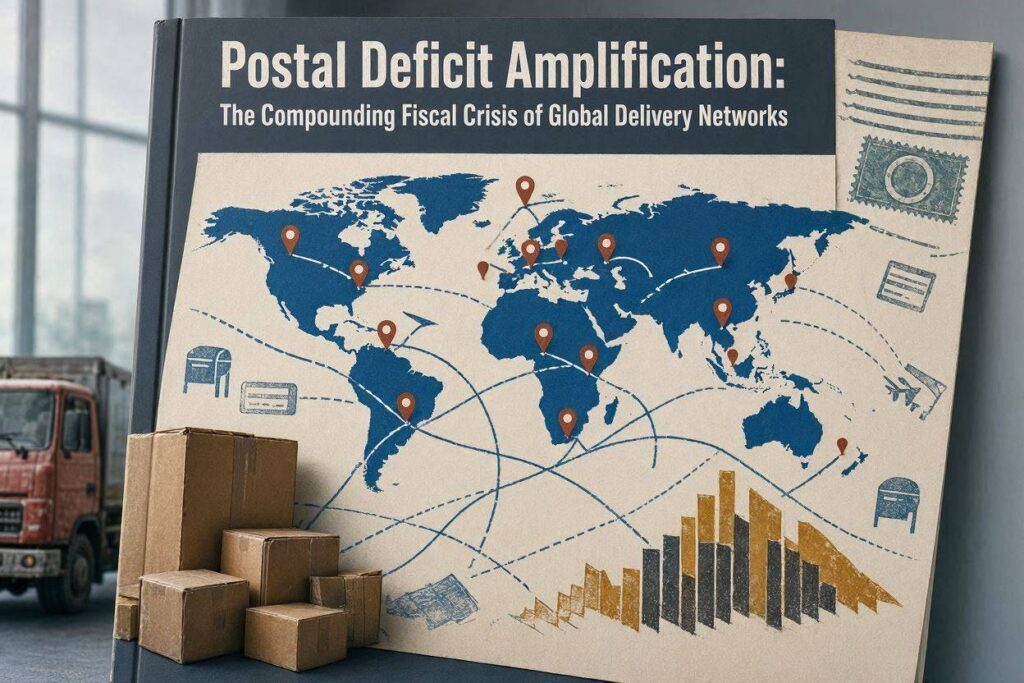
Historically, state-owned postal operators (like the USPS, Royal Mail, or Deutsche Post) balanced their books because high-margin letter mail subsidized the costly “Universal Service Obligation” (USO)—the mandate to deliver to every single address, no matter how remote, at a flat rate. Today, a vicious cycle of declining mail volumes, soaring labor costs, rigid regulatory frameworks, and aggressive private competition has created a perfect storm. The deficit is no longer a static budget gap; it is an self-amplifying fiscal drain.
1. The Anatomy of Postal Deficit Amplification: Modern Challenges
Modern postal deficits are not caused by simple mismanagement. They are driven by systemic, structural friction points where every traditional solution often makes the deficit worse.
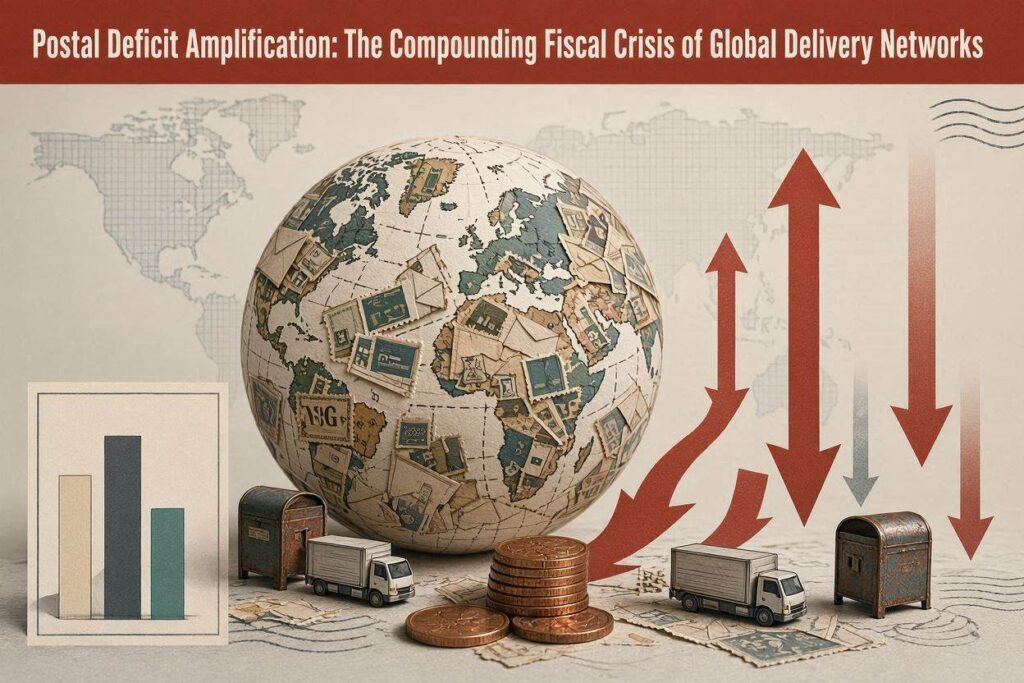
* Challenge 1: The “Death Spiral” of Price Hikes (Elasticity Backlash)
When a postal service faces a deficit, its immediate regulatory response is to raise postage rates (GRI – General Rate Increases).
- The Amplification: Because digital alternatives (e-mail, secure portals, digital billing) are readily available, every rate hike pushes more businesses to abandon physical mail entirely.
- The Result: The volume drop outpaces the price increase. The postal service is left with fewer mail pieces to cover the same massive, fixed infrastructure costs, forcing yet another rate hike. This is the classic Postal Death Spiral.
* Challenge 2: The Unfunded Mandate of the Universal Service Obligation (USO)
As populations grow and suburban sprawl expands, the number of delivery points (physical addresses) increases every year.
- The Amplification: Even if a remote rural route only receives one letter a week, the postal carrier must drive that route six days a week.
- The Result: Postal networks face growing delivery networks (more stop points) alongside shrinking mail volumes (fewer paying items per stop). The marginal cost of delivery increases while marginal revenue plummets.
* Challenge 3: Underfunded Pension Legacies and “Pre-Funding” Traps
Many national postal networks are weighed down by decades of legacy pension commitments and retiree healthcare liabilities.
- The Amplification: Governments have historically mandated strict, aggressive pre-funding targets for these benefits (requiring the post office to fund retirement benefits decades in advance).
- The Result: Billions of dollars in operating cash are legally locked away to cover future liabilities, starving the postal operator of the capital needed to modernize sorting hubs, automate fleets, and compete with private logistics giants.
* Challenge 4: The Last-Mile Dumping Ground (Asymmetrical 3PL Arbitrage)
Private e-commerce giants and third-party logistics (3PL) providers have built highly efficient delivery networks in high-density urban areas.
- The Amplification: Private carriers “cherry-pick” profitable, dense urban deliveries. However, for difficult, unprofitable rural deliveries, they drop the packages into the public postal system (known as postal injection).
- The Result: The public postal system is forced to handle the most expensive, low-margin “last-mile” segments of the delivery chain, while private competitors pocket the high-margin urban revenues.
* Challenge 5: Fleet Obsolescence and the Capital Expenditure (CapEx) Deadlock
To curb deficits, postal operators often delay upgrading their vehicle fleets.
- The Amplification: Operating aging, gas-guzzling delivery trucks results in skyrocketing maintenance costs and extreme vulnerability to fuel price volatility.
- The Result: Trying to save capital by delaying upgrades actually increases day-to-day operating deficits. Meanwhile, competitors adopt electric vehicles (EVs) and automated sorting, widening the efficiency gap.
* Challenge 6: Political and Regulatory Gridlock
Unlike private corporations, public postal services cannot easily shut down unprofitable branches, reduce delivery days (e.g., stopping Saturday delivery), or change pricing without legislative approval.
- The Amplification: Any attempt to streamline operations to match modern demand is met with intense political resistance, public outcry, and union opposition.
- The Result: Postal operators remain structurally frozen in a 20th-century operational model while trying to survive in a 21st-century digital economy.
2. Point-to-Point Mitigation Strategies to Halt the Deficit Spiral
Halting postal deficit amplification requires moving away from minor postage tweaks and embracing radical structural reforms.
                  [ Postal Deficit Occurs ]
                             │
                             ▼
                 [ Traditional Price Hike ]
                             │
                             ▼
              [ Digital Substitution Accelerates ]
                             │
                             ▼
              [ Mail Volume Drops Exceed Price Gains ]
                             │
                             ▼
             [ FIXED COSTS SPREAD OVER FEWER PIECES ]
                             │
                             ▼
             [ Deficit Amplified (The Death Spiral) ]
* Strategy A: Modernizing the USO (Dynamic Delivery Schedules)
The rigid mandate of six-day physical mail delivery for non-essential paper must be reformed.
- The Strategy: Transition to alternate-day delivery for standard letters, while maintaining daily delivery only for urgent medical supplies and express parcels.
- The Benefit: This instantly reduces fuel consumption, vehicle wear-and-tear, and labor costs without cutting off access to remote communities.
* Strategy B: Public-Private Logistical Integration
Instead of fighting private couriers, postal networks should formalize their role as the national backbone.
- The Strategy: Charge private carriers a standardized, regulated, and profitable “universal access fee” for injecting parcels into the last-mile network.
- The Benefit: This ensures that when private firms offload rural parcels onto the post office, they pay a price that fully covers the cost of delivery, reversing the arbitrage.
* Strategy C: Post Office Co-Location and Public Service Hubs
Physical post office buildings in rural and suburban areas represent a massive, underutilized real-estate footprint.
- The Strategy: Transform local post offices into multi-service hubs hosting government services, basic banking, digital printing, and public high-speed internet kiosks.
- The Benefit: This spreads the fixed cost of the brick-and-mortar retail footprint across multiple municipal and commercial budgets, reducing the burden on the postal balance sheet.
* Strategy D: Aggressive Automation and AI Route Optimization
Manual sorting and legacy dispatching are major sources of operational waste.
- The Strategy: Deploy AI-driven dynamic routing software that recalculates a carrier’s path daily based on actual parcel volume rather than fixed, historic routes.
- The Benefit: This dramatically lowers fuel costs and maximizes delivery density, turning the expensive last-mile into an optimized, data-driven process.
3. Key Financial Indicators of Deficit Amplification
Postal financial analysts must monitor these specific warning signs to identify when a deficit is transitioning from a linear issue to an amplified crisis:
| Metric | Formula / Description | Critical Warning Sign |
| Volume Elasticity Coefficient | % Change in Mail Volume / % Change in Postage Price. | A value less than -1.0 (Meaning price hikes cause a net loss in revenue). |
| Delivery Point Density Cost | Total Operational Cost / Total Active Delivery Addresses. | Rising cost per address while average revenue per address is falling. |
| Last-Mile Subsidy Ratio | Cost of Rural Last-Mile Delivery / Average Parcel Postage Revenue. | When the cost of delivering a parcel exceeds the postage collected. |
| Fixed-to-Variable Cost Ratio | Proportion of operating costs that cannot be adjusted in the short term. | A high fixed-cost base makes the network highly vulnerable to sudden volume drops. |