

For decades, microprinting—the technique of rendering extremely small text, patterns, or symbols (typically between 0.3 to 1 point in size)—stood as the gold standard of document security and anti-counterfeiting. Embedded within high-value assets such as banknotes, passports, pharmaceutical packaging, and high-end luxury labels, its core strength relied on a simple premise: standard commercial scanners, photocopiers, and consumer printers lacked the resolution to reproduce microscopic text. Instead of copying the crisp microtext, unauthorized duplicators would output blurred, smudged, or solid lines, exposing the fraud immediately.
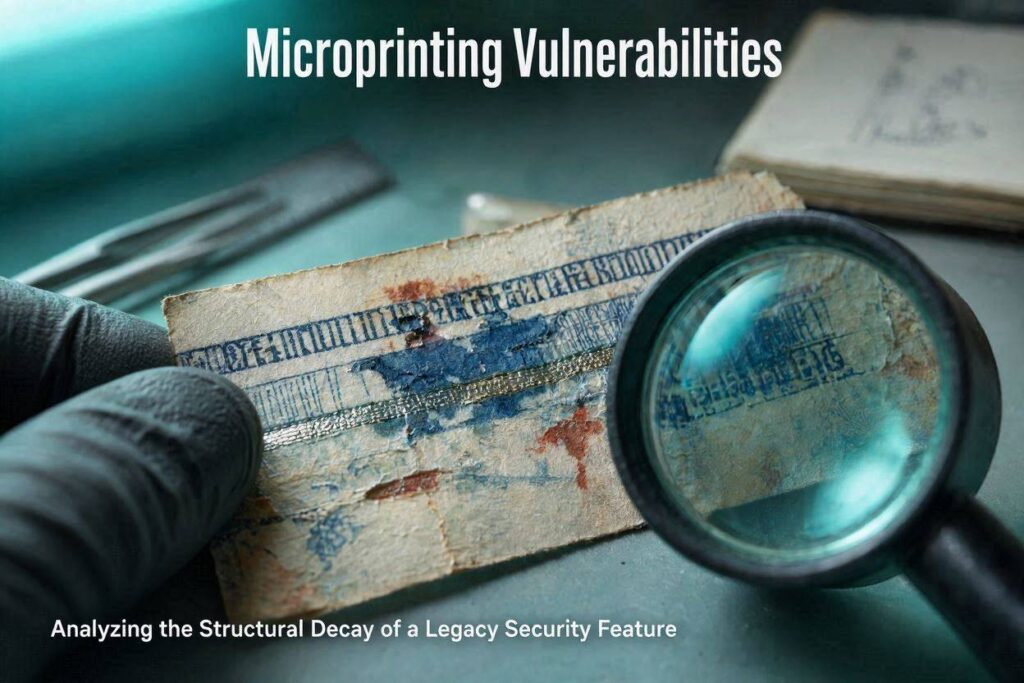
However, rapid advancements in digital imaging, high-precision industrial manufacturing, and AI-assisted reproduction have changed the game. What was once an elite security shield is now facing significant vulnerabilities. Today, microprinting is experiencing structural decay as a standalone security feature, presenting a new wave of challenges for security printers and brand managers worldwide.
1. The Core Vulnerabilities: Modern Technical Challenges
The rapid democratization of high-resolution technology has systematically broken down the technical barriers that once kept microprinting secure.
* The Consumer Technology Convergence (High-DPI Scanning & Printing)
The primary vulnerability of microprinting is the widespread availability of consumer-grade, ultra-high-density scanning and printing hardware.
- The Reality: Modern commercial inkjet and laser printers regularly exceed resolutions of 4800 to 9600 DPI (dots per inch).
- The Vulnerability: Counterfeiters no longer require million-dollar intaglio presses to replicate basic microtext. Affordable, high-precision desktop equipment can scan and print legible characters down to 0.3 points, allowing illicit actors to bypass low-level visual inspections entirely.
* The Friction of “Frictionless” Verification
Historically, microtext was meant to be checked using magnifying glasses, specialized loupes, or high-magnification scanners.
- The Reality: In fast-moving logistics chains and retail checkout lanes, expecting inspectors, border agents, or consumers to pull out a magnifying glass is highly impractical.
- The Vulnerability: Because manual verification is slow, it is rarely performed. This “inspection gap” allows high-quality counterfeits to bypass real-world checks simply because no one is actively looking at the microscopic details.
* Environmental Degeneracy and Wear-and-Tear
Microprinted text is extremely sensitive to physical handling and environmental exposure.
- The Reality: Friction, moisture, heat, and UV exposure quickly degrade paper and polymer substrates.
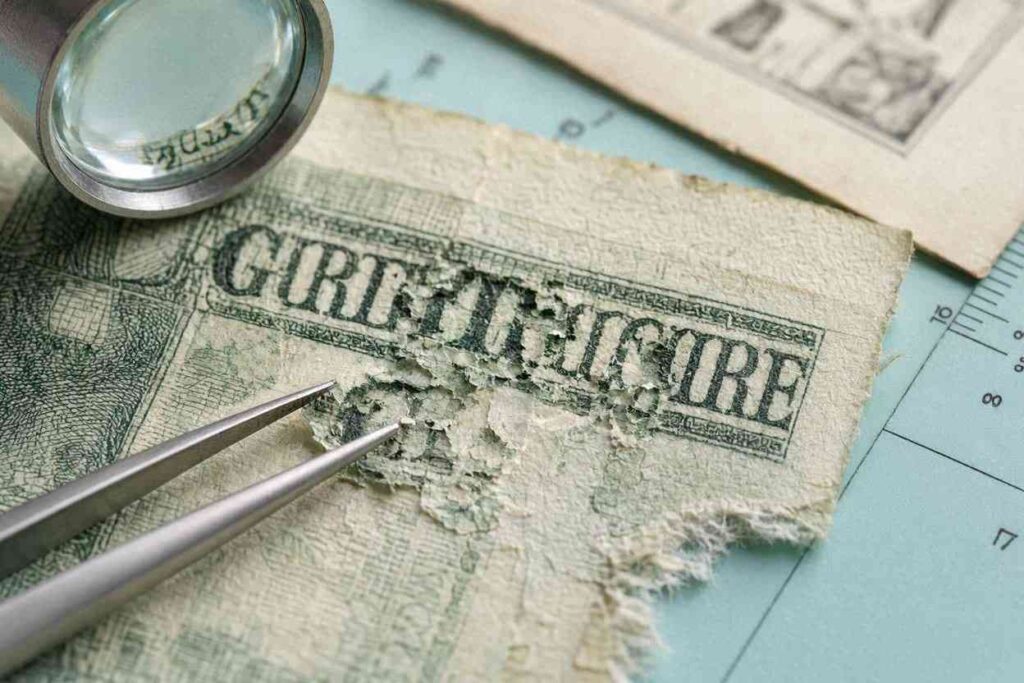
- The Vulnerability: A genuine document (such as an identification card or passport) can easily suffer localized fading or smudging over years of active use. When authentic microtext blurs due to normal wear, it mimics the visual signature of a counterfeit, leading to false positives during security checks and undermining the utility of the feature.
* Generative AI Vector Reconstruction
Counterfeiters are leveraging generative AI and machine learning image-to-vector algorithms to rebuild imperfect scans.
- The Reality: When a physical document is scanned, the microprinting may suffer from slight digital noise or optical distortion.
- The Vulnerability: AI-driven upscaling models can analyze distorted microprint, predict the original character structures, and output a perfectly sharp, vectorized replica ready for high-resolution plate engraving. This eliminates the scanning “blur” that historically protected genuine assets.
* Industrial-Scale Micro-Fabrication Spillage
Advanced micro-fabrication technologies, such as photolithography and nano-imprint lithography, are moving beyond high-tech semiconductor labs.
- The Reality: Overseas illicit manufacturing syndicates have acquired decommissioned or grey-market industrial lithography equipment.
- The Vulnerability: This high-end hardware allows counterfeiters to replicate microtext and microscopic security patterns at a sub-micron scale, achieving a level of sharpness that easily defeats basic laboratory forensic analysis.
2. Dynamic Point-to-Point Strategies to Fortify Microprinting
To counter these modern vulnerabilities, organizations must stop viewing microprinting as an isolated security measure. Instead, it must be integrated into a multi-layered, hybrid defense framework.
                [ Legacy Microprinting (Vulnerable) ]
                                  │
                  ( Add Sophisticated Overlays )
                                  ▼
                [  HYBRID MULTI-LAYERED SECURITY  ]
                  ├── 1. Microtext + Color-Shifting Ink
                  ├── 2. Machine-Readable Fluorophores
                  └── 3. Cryptographic QR Core Integration
                                  │
                                  ▼
             [ Highly Resistant to Modern Replication ]
* Strategy A: Transitioning to Multi-Spectral Ink Integration
Standard monochrome microprinting is highly vulnerable to modern scanners.
- The Defense: Print microtext using specialized, multi-spectral security inks, such as Infrared-Upconverting (IR), Ultraviolet (UV) fluorescent, or Color-Shifting (OVI) inks.
- The Outcome: Even if a counterfeiter uses a high-DPI printer to copy the exact text layout, the copy will fail to react or shift color when exposed to specific wavelengths of light, making detection quick and definitive.
* Strategy B: Seamless Cryptographic Coupling
Physical security features should link directly with digital validation architectures.
- The Defense: Embed microprinted characters directly inside high-security, encrypted 2D barcodes or secure QR codes.
- The Outcome: The macro-element (the barcode) is scanned instantly via smartphone, while the micro-element embedded within the code’s borders provides an extra, forensic-level layer of authentication that prevents simple code-cloning.
* Strategy C: Automated Mobile AI Authentication
To eliminate the need for manual magnifying glasses, utilize mobile computing power.
- The Defense: Develop mobile verification apps equipped with AI-driven computer vision algorithms.
- The Outcome: By utilizing the high-megapixel macro lenses standard on modern smartphones, the app can instantly magnify, read, and verify the microprinting on a label or document. This automates the verification process and removes human error.
3. Comparing Legacy vs. Next-Generation Microprinting
To maintain an effective anti-counterfeiting strategy, secure printing houses must evaluate the differences between outdated and modernized implementation formats:
| Feature Attribute | Legacy Microprinting (Vulnerable) | Next-Gen Secure Microprinting |
| Spectral Profile | Standard monochrome or basic CMYK process ink. | Multi-spectral, UV/IR-reactive, or taggant-loaded ink formulations. |
| Verification Method | Manual optical magnification (loupes, magnifying glasses). | High-resolution smartphone cameras paired with AI pattern-matching. |
| Replication Risk | High; easily bypassed by modern commercial printers and generative AI upscaling. | Extremely low; requires proprietary chemical ink synthesis and precision lithography. |
| Fulfillment Context | Static, isolated lines or background Guilloché patterns. | Dynamic integration within serialized barcodes and encrypted matrices. |