

In the logistics and postal sector, Postal Revenue Cannibalization refers to the phenomenon where a postal authority’s or logistics provider’s own new services, digital alternatives, or structural shifts inadvertently erode its legacy, high-margin revenue streams.
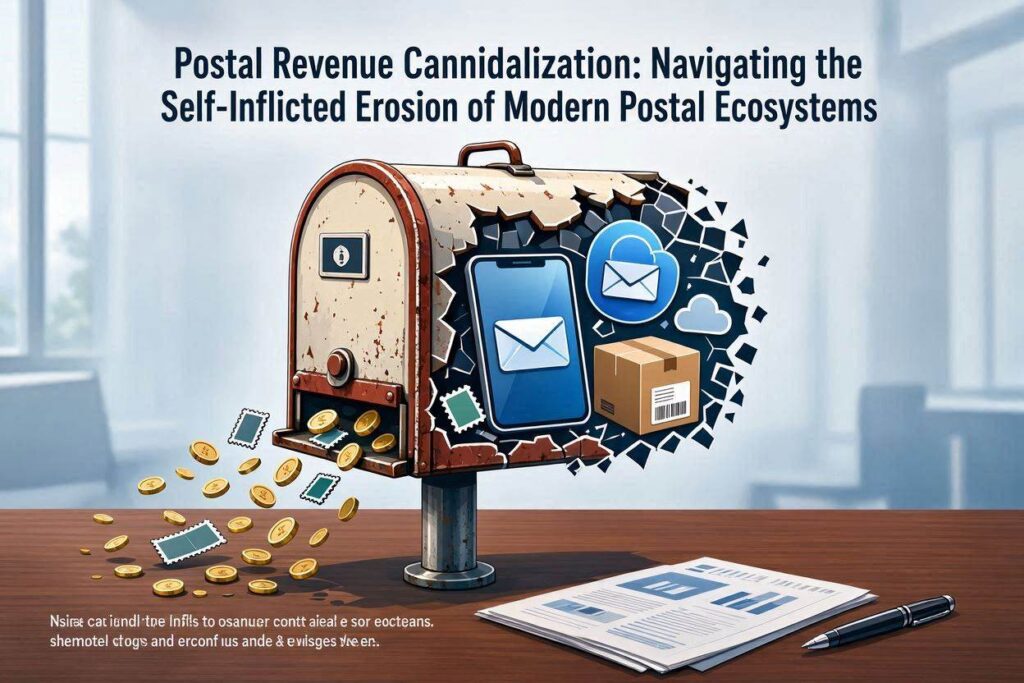
Historically, postal services relied on high-margin First-Class mail to subsidize expensive universal delivery networks. Today, as postal operators rapidly innovate to keep pace with e-commerce, they face a delicate balancing act: introducing new services to stay relevant while trying not to cannibalize the very services that keep them financially solvent.
1. The Anatomy of Modern Postal Revenue Cannibalization
Revenue cannibalization is no longer just about “email replacing paper letters.” The modern challenges are highly structural, operational, and driven by advanced digital technologies.
* Challenge 1: The First-Class Mail to E-Commerce Parcel Shift (Margin Dissolution)
Traditional paper mail (First-Class) has exceptionally high profit margins because it is highly standardized, lightweight, and automated.
- The Issue: Postal operators are aggressively expanding their e-commerce parcel divisions to offset the decline of paper mail.
- The Cannibalization: While parcel volumes are soaring, their operational margins are razor-thin compared to paper. Parcels require manual sorting, larger delivery vehicles, and complex last-mile logistics. In essence, low-margin parcels are cannibalizing high-margin letter mail, leaving operators with higher revenues but significantly lower net profits.
* Challenge 2: Digital Government & E-Invoicing Mandates
Many state-owned and private postal operators historically generated massive, recurring revenue from official government communication, utility bills, and bank statements.
- The Issue: Governments worldwide are pushing for mandatory “Digital Citizens’ Portals,” electronic invoicing (e-invoicing), and digital voting.
- The Cannibalization: By actively supporting or integrating with digital identity and secure online portal projects, postal networks are accelerating the death of their most reliable bulk-transactional mail volumes. They are funding the digital infrastructure that directly cannibalizes their paper-delivery cash cows.
* Challenge 3: Hybrid Mail and Regional “Co-Mingle” Injection
To appeal to budget-conscious bulk mailers, postal systems often offer heavily discounted entry rates for pre-sorted, regionally consolidated mail.
- The Issue: Third-party logistics (3PL) providers and consolidators collect mail from various businesses, sort it using advanced software, and drop it directly at the final local delivery office (postal injection).
- The Cannibalization: While this reduces sorting labor for the postal system, it cannibalizes the highly lucrative “end-to-end” sorting and transport revenues. The postal service is left doing the most expensive, labor-intensive part—the physical doorstep delivery—for a fraction of the original postage price.
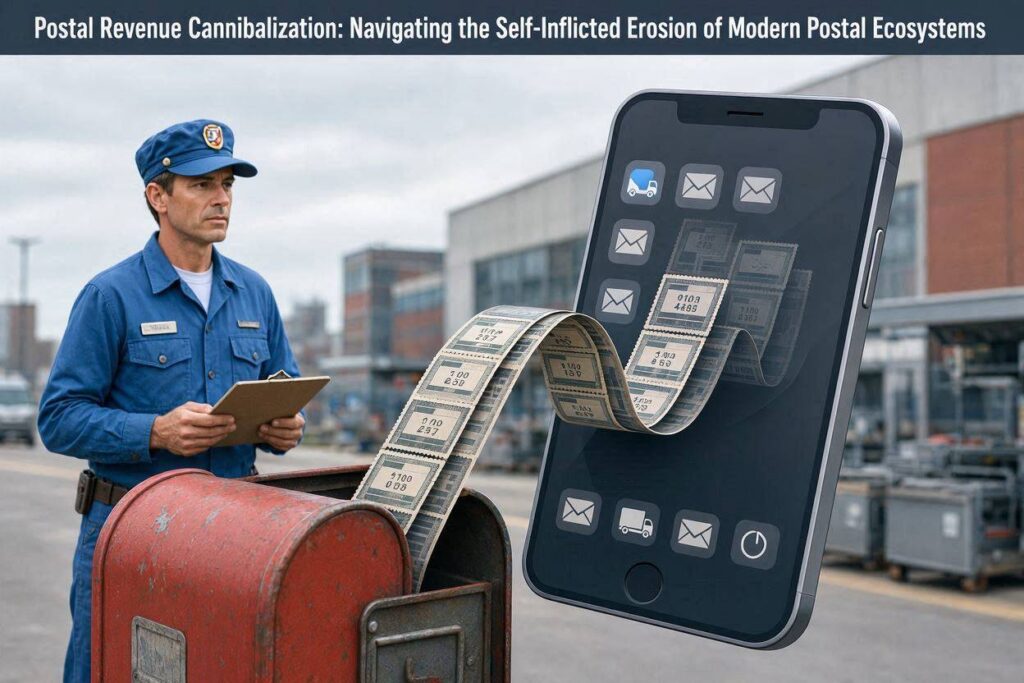
* Challenge 4: The Rise of “Smart” Out-of-Home (OOH) Delivery vs. Home Delivery
To optimize delivery costs, postal networks are investing heavily in locker networks (Smart Lockers) and PUDO (Pick-Up, Drop-Off) points.
- The Issue: Lockers consolidate dozens of deliveries to a single GPS point, reducing delivery van miles.
- The Cannibalization: As carriers incentivize consumers to use lockers through cheaper rates, they cannibalize their premium “Home Delivery” services. Over time, consumers refuse to pay the higher home-delivery premiums, driving down the overall Average Revenue Per Parcel (ARPP) across the network.
* Challenge 5: In-House Logistic Consolidation by E-Commerce Giants
Major marketplace platforms historically accounted for the majority of postal parcel volumes.
- The Issue: To reduce dependency on postal networks, these retail giants build their own last-mile delivery fleets.
- The Cannibalization: They offload only the most remote, rural, and unprofitable “last-mile” packages to the public postal service while keeping the dense, profitable urban routes for their own fleets. This cherry-picking cannibalizes the profitable urban revenue bases that postal networks rely on to subsidize rural universal service obligations (USO).
* Challenge 6: API-Driven Service Down-Grading
Shipping software platforms now use predictive algorithms to advise e-commerce merchants on the exact service speed required to meet a delivery promise.
- The Issue: Historically, merchants paid a flat premium for “Priority/Express” 2-day shipping.
- The Cannibalization: AI-driven multi-carrier software now realizes that a standard, cheaper ground service can reach a nearby destination in the same 2-day window. Consequently, merchants systematically downgrade their service selection from premium air/express to standard ground, cannibalizing the postal operator’s high-yield express revenues.
2. Strategic Countermeasures to Mitigate Cannibalization
To survive self-cannibalization, postal operators must evolve from simple “delivery networks” into value-added digital and physical ecosystems.
* Strategy A: Value-Added Digital Identity Monetization
Instead of fighting digital substitution, postal operators should own the digital delivery space.
- How it works: Establish secure, verified digital mailboxes tied to physical addresses.
- The Mitigation: Charge utility companies, financial institutions, and government bodies a secure transaction fee to deliver digital documents through this certified platform. This replaces lost physical postage revenue with high-margin digital transaction fees.
* Strategy B: Tiered Last-Mile Delivery Monetization
Postal operators must stop pricing home delivery as a standard default option.
- How it works: Position home delivery as an premium luxury option, while making PUDO (Pick-Up, Drop-Off) and Smart Lockers the baseline standard.
- The Mitigation: By charging a distinct premium for doorstep delivery, operators protect home-delivery margins from being cannibalized by low-cost parcel expectations.
* Strategy C: Dynamic “Sparsity-Based” Pricing Models
Universal Service Obligations (USO) usually force postal networks to charge the same rate regardless of geographic destination. Operators must lobby to reform these outdated regulations.
- How it works: Implement surcharge-based pricing for extremely rural or hard-to-reach locations.
- The Mitigation: This prevents e-commerce giants from dumping unprofitable rural parcels onto the postal network without paying a premium that offsets the high operational cost.
* Strategy D: B2B Micro-Fulfillment Partnerships
Instead of merely carrying parcels from warehouse to home, postal operators can monetize their underutilized real estate (local post offices).
- How it works: Convert local, urban post offices into micro-fulfillment hubs where brands can store inventory closer to buyers.
- The Mitigation: Operators generate warehousing and picking fees, converting real estate costs into high-margin logistics revenue that cushions the blow of declining mail volume.
3. Key Metrics for Monitoring Revenue Cannibalization
Postal CFOs and analysts must track these vital indicators to measure structural decay:
| Metric | Calculation / Description | Target Objective |
| First-Class to Parcel Margin Ratio | Net margin of letter mail vs. parcel mail. | Stabilize the ratio; ensure parcel yield increases as letter volume drops. |
| Out-of-Home (OOH) Substitution Rate | Percentage of customers choosing lockers over home delivery. | Optimize to ensure locker cost-savings exceed the loss in home-delivery premiums. |
| Bulk Mail Pre-Sort Leakage | Revenue lost to third-party consolidators injecting pre-sorted mail. | Cap leakage by offering competitive direct-volume tier pricing. |
| Average Revenue Per Parcel (ARPP) | Total parcel revenue divided by total parcel volume. | Must remain positive and rise above the rate of local operational inflation. |